Press Clips-2 Index
81. The second world
war Counting the cost
http://www.economist.com/node/21556542/print
http://www.economist.com/node/21556542/print
82. Natural disasters Counting the cost
of calamities
http://www.economist.com/node/21542755/print
83. Scientists close in on 'God particle'
84. AIR-CONDITIONING - Relief
in every window, but global worry too
http://www.ndtv.com/article/india/relief-in-every-window-but-global-worry-too-234684
85. Farm suicides rise in Maharashtra , State
still leads the list
http://www.thehindu.com/opinion/columns/sainath/article3595351.ece?css=print
86. The process within the LHC
87. Punjab ’s new
challenge: uranium in ground water
88. Is the
Onslaught Making Us Crazy?
http://www.i4u.com/2012/07/onslaught-making-us-crazy
89. Who's very important? It's the 'common person'
90. How Editors are managed
92. Delhi
93. Private firms can’t claim mining rights, rules
court
http://www.thehindu.com/news/national/article3718639.ece?css=print
94.
Lessons for China in India
95. Where Streets Are Thronged With Strays
Baring Fangs
http://www.nytimes.com/2012/08/07/world/asia/india-stray-dogs-are-a-menace.html?_r=1&pagewanted=2&emc=eta1&pagewanted=print
96. Pages apart
http://www.thehindu.com/opinion/op-ed/article3882460.ece?css=print
97. We Are Now One Year Away From Global
Riots, Complex Systems Theorists Say- http://motherboard.vice.com/2012/9/10/we-are-now-one-year-and-counting-from-global-riots-complex-systems-theorists-say--2
98. India
99. Ordinance
moots death penalty if rape victim dies or slips into coma - TOI
Press Clips
http://www.economist.com/node/21556542/print
The second world war
Counting the cost
Two British historians analyse the 20th century’s worst conflict
Jun 9th 2012 | from the print edition

All Hell Let Loose: The World at War 1939-1945. By Max Hastings. HarperPress; 748 pages; £30. Buy from Amazon.co.uk
The Second World War. By Antony
HISTORY is full of wars that were bloodier than the second world war. As a proportion of the population, more people were killed during the An Lushan rebellion in eighth-century China , for example, or by the Thirty Years War in 17th-century central Europe . But the sheer magnitude of the human tragedy of the second world war puts it in a class of its own, and its relative closeness to the present day makes claims on the collective memory that more remote horrors cannot.
The statistics of the war are almost mind-numbing. Estimates differ, but up to 70m people died as a direct consequence of the fighting between 1939 and 1945, about two-thirds of them non-combatants, making it in absolute terms the deadliest conflict ever. Nearly one in ten Germans died and 30% of their army. About 15m Chinese perished and 27m Soviets. Squeezed between two totalitarian neighbours, Poland
Partly because it is so hard to grasp what these numbers mean, recent historians have tended to concentrate on particular theatres or aspects of the war with an emphasis on trying to describe what it was like for the human beings caught up in it. Both Antony Beevor and Max Hastings are distinguished exemplars of this approach. Mr Hastings has written books on Britain ’s strategic bombing campaign, the Allied invasion of Normandy and the battles for Germany and Japan Berlin
Mr Hastings got there before Mr Beevor. “All Hell Let Loose” was published seven months ago (it is now out in paperback) to justifiably rave reviews. Mr Hastings’s technique is to mine the written record of those who took part both actively and passively. His witnesses range from the men whose decisions sent millions to their deaths to the ordinary soldiers who carried out their orders and the civilian victims who found themselves on the receiving end. Cynicism and idealism, suffering and euphoria, courage and terror, brutalisation and sentimentality—all find expression through their own testimony. From the Burma Road to the Arctic convoys, the killing fields of Kursk
Less so are some of his judgments. Although delivered with verve and economy (Mr Hastings is, above all, an accomplished journalist), they are often unfair. For example, he argues that the decision by Britain and France to declare war because of the German attack on Poland Germany
Mr Hastings’s repeated admiration for the fighting qualities of German, Japanese and Soviet soldiers compared with British and American forces is especially trying. Germany and Japan
The majority of the civilian soldiers of the Western democracies, by contrast, just wanted to survive and return to normal life as soon as possible. That also meant that American and British generals had to eschew the dashing aggression of their Russian and German counterparts, who could squander lives with impunity. Thanks to the bloodbath in Russia
Mr Hastings excessively admires two German field-marshals: Gerd von Rundstedt and Eric von Manstein, whereas only Bill Slim and George Patton rise above the general mediocrity of Allied field commanders. Luckily, the tactical virtuosity of the Germans and Japanese was more than matched by their strategic incompetence in declaring war against Russia and America
Close connections
Overall, however, Mr Hastings does an admirable job of weaving together deeply personal stories with great events and high strategy. This raises the question of whether another book covering essentially the same ground is necessary. The answer depends on what the reader is looking for. Mr Beevor, who is known for using the sometimes unbearably moving diaries and letters of ordinary soldiers to shed new light on old battles, is otherwise less generous than Mr Hastings in the space he gives to primary sources. He has written what is in many ways a more conventional military history. But where he is good, he is very good.
Mr Beevor is full of insight about the connections between things—he sets out “to understand how the whole complex jigsaw fits together”. Thus the relatively little-known Battle of Khalkhin-Gol, in which Japan’s plans to grab Soviet territory from its base in Manchuria were undone in the summer of 1939 by the Red Army’s greatest and most ruthless general, Georgi Zhukov, had profound consequences. The Japanese “strike south” party prevailed over the “strike northers”, ensuring that Stalin would not have to fight a war on two fronts when the Germans launched Operation Barbarossa in 1941. Mr Beevor decries the rebarbative “Bomber” Harris’s attempt to win the war by bringing death and destruction to every major German city as a moral and strategic failure. But he also points out that by forcing the Nazis to move squadrons of Luftwaffe fighters from Russia
Mr Beevor also has a surer hand than Mr Hastings in describing how the great land battles of the war unfolded. Although his judgments are less waspishly entertaining than his rival’s, they are also more measured. He is notably more generous about Britain ’s contribution to defeating Hitler, which Mr Hastings at times appears to think was mainly confined to the code-breaking centre at Bletchley Park
Mr Beevor is keener than Mr Hastings on detailing the horror. He is particularly vivid in describing the barbarities that became commonplace during the carnage on the Eastern front. Frozen German corpses littering the battlefield were frequently missing their legs, not because they had been blown off, but because Red Army soldiers wanted their boots and could only pull them off after the legs had been defrosted over camp fires. Outside the besieged city of Leningrad
The cruelties perpetrated by the Japanese against civilians in China (Mr Beevor sees the Sino-Japanese conflict that began with the Nanking massacre in 1937 as the true opening chapter of the second world war) and any of the countries unfortunate enough to come within the “Greater East Asia Co-Prosperity Sphere” were nearly as systematic as any of the crimes committed by the Nazis. Japanese commanders actively encouraged the dehumanisation of their troops in the belief it would make them more formidable. Prisoners were burned on huge pyres in their thousands and killing local people for meat was officially sanctioned.
Mr Beevor also gives more attention than Mr Hastings to the appalling acts of violence suffered by women when invading armies arrived. Again, it was the Japanese who set about mass-rape with methodical zeal. Hundreds of thousands of Chinese and Korean girls were press-ganged into becoming “comfort women”; 10,000 women were gang-raped after the fall of Hong Kong . But revenge-fuelled Red Army soldiers were little better. Soviet forces looting and pillaging their way through East Prussia on their way to Berlin raped around 2m women and girls.
This is, however, a less satisfying book than Mr Beevor’s earlier, more focused works. There is an unevenness of quality. The author has a tremendous grasp of the things he has written about before, in particular the titanic struggle between Hitler and Stalin. But he is dutiful rather than exhilarating when dealing with some other passages and theatres of the war. The account of the campaign in north Africa plods, and American readers may be disappointed by his handling of the war in the Pacific. The battle of Midway, arguably the defining naval engagement between Japan and America
_____________________________________
Natural disasters
Counting the cost of calamities
Death rates from natural disasters are falling; and fears that they have become more common are misplaced. But their economic cost is rising relentlessly
Jan 14th 2012 | ROTTERDAM, NETHERLANDS AND WASHINGTON, DC | from the print edition

THE world’s industrial supply chains were only just recovering from Japan’s earthquake and tsunami in March when a natural disaster severed them again in October. An unusually heavy monsoon season swelled rivers and overwhelmed reservoirs in northern Thailand. The floodwaters eventually reached Bangkok, causing a political crisis as residents fought over whose neighbourhoods would flood. But before that the economic toll was being felt farther north in Ayutthaya province, a manufacturing hub. The waters overwhelmed the six-metre-high dykes around the Rojana industrial estate, one of several such parks that host local- and foreign-owned factories.
Honda’s workers rescued newly built cars by driving them to nearby bridges and hills. The factory ended up under two metres of water and is still closed. Honda was hardly alone: the industrial estates that radiate out from Bangkok are home to many links in the world’s automotive and technology supply chains. Western Digital, a maker of computer disk drives which has 60% of its production in Thailand, had two of its factories closed by the floods, sending the global price of drives soaring.
Thailand is no stranger to floods. Europeans once called Bangkok the “Venice of Asia”. But rarely have they done so much economic damage. October’s deluge cost $40 billion, the most expensive disaster in the country’s history. J.P. Morgan estimates that it set back global industrial production by 2.5%.
Such multi-billion-dollar natural disasters are becoming common. Five of the ten costliest, in terms of money rather than lives, were in the past four years (see map). Munich Re, a reinsurer, reckons their economic costs were $378 billion last year, breaking the previous record of $262 billion in 2005 (in constant 2011 dollars). Besides the Japanese and Thai calamities, New Zealand suffered an earthquake, Australia and China floods, and America a cocktail of hurricanes, tornadoes, wildfires and floods. Barack Obama issued a record 99 “major disaster declarations” in 2011.

Acts of God, or man?
Although deadly quakes are rarely blamed on human activity, it is fashionable to blame weather-related disasters on global warming. It does seem plausible: warm air worsens droughts and lets tropical air hold more moisture, the fuel for cyclones (weather formations that include hurricanes and typhoons). However, a recent study by the Intergovernmental Panel on Climate Change, which represents the consensus among thousands of scientists, expressed little confidence in any link between climate change and the frequency of tropical cyclones.
The world has succeeded in making natural disasters less deadly, through better early-warning systems for tsunamis, better public information about evacuation plans, tougher building codes in quake-prone areas and encouragement for homeowners to adopt simple precautions such as installing tornado-proof rooms in their homes. Annual death tolls are heavily influenced by outliers, such as Haiti’s earthquake in 2010 (which killed more than 200,000) or the Bangladeshi cyclones in 1970 (300,000). But, adjusted for the Earth’s growing population, the trend in death rates is clearly downward.
However, even if natural disasters may be no more common and no more likely to kill people than before, there is no doubt that their economic cost is rising. This is because a growing share of the world’s population and economic activity is being concentrated in disaster-prone places: on tropical coasts and river deltas, near forests and along earthquake fault lines.
Thailand is an example of this. Since its last serious floods, in 1983 and 1995, the country’s export-oriented industrial base has grown rapidly in the provinces around Bangkok and farther north along the Chao Phraya River. Ammar Siamwalla, a Thai economist, notes that the central plain where many industrial estates now sit was once heavily cultivated for rice precisely because it floods regularly. Although dykes (called levees in America) protect these estates and central Bangkok, they may raise water levels, and thus the risk of flooding, elsewhere.
Wildfires, which destroyed thousands of homes in Texas in 2011 and in Australia in 2009, were more destructive than hitherto because, as populations have grown, new housing has been built in wooded areas. Throughout America’s west and south-west, encroaching suburbia has put pressure on forest managers to suppress fires as quickly as possible. Yet repeated fire suppression allows forests to accumulate more fuel which can lead to more intense and devastating fires later on.
Australia’s “Black Saturday” bushfires (pictured above), which killed 173 people and destroyed 2,298 homes in 2009, were said to be the country’s worst natural disaster. But a study by Ryan Crompton of Macquarie University and others found that 25% of the destroyed buildings were in bushland and 60% were within ten metres of it, and thus exposed to the threat of fire. The study concluded that if previous fires had occurred with people living so close to the bush as today, a 1939 outbreak of wildfires would have been the deadliest while Black Saturday’s would rank second, and only fourth by number of buildings destroyed.
In harm’s way
America’s coasts may be a microcosm of where the world is headed. Florida’s population has grown from 2.8m in 1950 to 19m now. Howard Kunreuther and Erwann Michel-Kerjan, disaster experts at the Wharton business school in Pennsylvania, reckon there are now nearly $10 trillion of insured and hurricane-prone assets along the coast from Maine round the Florida peninsula to Texas. Roger Pielke of the University of Colorado at Boulder reckons that the Great Miami Hurricane of 1926, which cost $1 billion in 2011 dollars, would cause $188 billion of damage now.
Whether the economic toll of disasters is rising faster than global GDP is unclear, since a wealthier world naturally has more wealth at risk. Still, the incidence of spectacular, multi-billion-dollar catastrophes seems certain to rise. A 2007 study led by the OECD reckoned that by 2070, seven of the ten greatest urban concentrations of economic assets (buildings, infrastructure and the like) that are exposed to coastal flooding will be in the developing world; none was in 2005. In that time, assets exposed to such flooding will rise from 5% of world GDP to 9%. A World Bank study led by Apurva Sanghi estimated that between 2000 and 2050 the city populations exposed to tropical cyclones or earthquakes will more than double, rising from 11% to 16% of the world’s population.
Development by its nature also aggravates risks. As cities encroach on coasts, wetlands and rivers, natural barriers such as mangrove swamps and sand dunes are obliterated and artificial ones—dykes and sea walls—are erected to keep the water out. The result is to put more people and property in harm’s way if those barriers fail. After the second world war Japan embarked on a vigorous programme of building seawalls and dykes to protect its cities against storm surges and tsunamis. That in turn encouraged cities’ growth and industrialisation, but for the same reason exposed them to damage if a tsunami overwhelmed their defences, as it did in March.
As cities on river deltas extract groundwater for industry, drinking and sanitation, the ground subsides, putting it further below sea level and thus requiring even higher dykes. Since 1980 Jakarta’s population has more than doubled, to 24m, and should reach 35m by 2020. Land that once absorbed overflow from the city’s 13 rivers has been developed, and is now subsiding; 40% of the city is now below sea level.
Perverse incentives
People originally settled in river deltas precisely because regular flooding made the land so fertile. Those cities have continued to grow because of the natural economic advantages such concentrations of human talent hold for modernising societies. Even when poor people moving to cities know they are increasing their risk of dying in a mudslide or flood, that is more than compensated for by the better-paying work available in cities. And in rich countries, coasts are gaining population simply because people like living near water.

Perverse incentives are also at work. In America, homeowners on floodplains must have flood insurance to get a federally backed mortgage. But federal insurance is often subsidised and many people are either exempt from the rule or live in places where flood risks have not been properly mapped. Some do not buy disaster insurance, assuming they can count on federal aid if their home is destroyed. Once the government declares a disaster, it pays 75-100% of the response costs. Presidents have found it increasingly hard to turn down pleas from local leaders for assistance, especially in election years. Matt Mayer of the Heritage Foundation, a conservative think-tank, says the government routinely takes charge of local disasters that should be well within a state’s capability. The result is that state disaster-management atrophies and disaster funding ends up subsidising disaster-prone places like Florida at the expense of safer states like Ohio.
As a consequence of these skewed incentives, people routinely rebuild in areas that have already been devastated. Bob Meyer of the Wharton School gives the example of Pass Christian, a resort town in Mississippi, where an apartment complex was destroyed by Hurricane Camille in 1969, killing 21 people who had taken refuge inside. A shopping centre and condominiums were later built in the same area, only to be wiped out by Hurricane Katrina in 2005, since when more new condominiums have gone up nearby.
This is not all because of incentives. As Mr Meyer says, people have a tendency not to price rare, unpredictable events into their decisions, even if these may have catastrophic consequences. Leo “Chipper” McDermott, the mayor of Pass Christian, notes that more than three decades elapsed between Camille and Katrina. “Life is a chance. And let me tell you something else: water sells.”
If human nature cannot be changed, government policy can be. That might mean spending more on preventing disaster so as to cut its costs. Roughly 20% of humanitarian aid is now spent responding to disasters, whereas a paltry (but rising) 0.7% is spent on preventive measures taken to mitigate their possible consequences, according to the World Bank.
A Dutch rethink
The Netherlands, whose existence has long been at the mercy of nature, may be at the forefront of rethinking how to cope with it. Some 60% of the country is either under sea level or at risk of regular flooding from the North Sea or the Rhine, Meuse and Schelt rivers and their tributaries. In 1953, a combination of a high spring tide and severe storm over the North Sea overwhelmed dykes, flooding 9% of its farmland and killing 1,800 people. The country responded with a decades-long programme of “delta works” to guard estuaries from storm surges, while raising and strengthening dykes.
The success of those defences has, perversely, made the consequences of failure even greater, says Piet Dircke of Arcadis, a Dutch engineering firm specialising in water management. Protected by the delta works and dykes, the land stretching from Amsterdam to Rotterdam has heavily industrialised and now provides most of the country’s output. “The northern and southern parts of the Netherlands are far more safe but are economically less attractive. People are moving to the western part of Holland because it’s where the economy grows.”
In 1993 and again in 1995 heavy river flooding inundated the countryside and nearly rose above dykes in population centres, forcing the evacuation of more than 250,000 people. Katrina was the final wake-up call, making the Dutch face up to both the unreliability of forecasts of once-in-a-century events and the impossibility of their repeating the American feat of evacuating a million people.
The country’s philosophy of flood control has as a result pivoted from building ever higher dykes to instead making its cities and countryside more resilient to floodwaters. In 2007 it launched its €2.3 billion “Room for the River” project. At 39 locations along the Meuse, Rhine, IJssel and Waal rivers, dykes are being moved inland, riverbeds deepened and fields now occupied by farms and households deliberately exposed to floods. The Dutch invented the word “polder” centuries ago to describe dry land created by enclosing floodplains (or shallow waters) with dykes. They are now “depolderising”, removing or lowering the surrounding dykes and turning land back into floodplains. The Rhine’s maximum flow without causing disaster will be raised from 15,000 cubic metres a second to 16,000 and, eventually, 18,000.
The Noordwaard polder south-east of Rotterdam was floodplain until 1973, when the delta works made it suitable for cattle and vegetables. It is now being turned back into floodplain to absorb floodwaters that might otherwise inundate cities upstream. To do so, the government had to persuade 18 farmers to move or have their farmhouses raised. Wim de Wit, who raises 75 cattle on the farm his father started in 1979, chose the latter. Near his farmhouse, earthmoving equipment is building a mound, or “terp,” on which a new one will sit, safe from the periodic floods that will follow. It will not be pleasant, Mr de Wit acknowledges, “but it’s only once every 25 years.” And if he loses any crops or cattle to floods, the government will compensate him.
The Dutch are building an industry of promoting their water-management philosophy around the world. Deltares, a research institute, recommends that the Thai government emulate Room for the River by moving dykes farther back where possible, limiting floodplain development and unifying water management so that safety is no longer subservient to irrigation and electricity generation.
 Pass Christian after Katrina passed
But the Dutch approach has limits. For one thing it is costly. Farmers were paid market value to leave the polders. To do this in a more densely populated city or industrial area would be prohibitively expensive. In America and China, the government has long had the right to breach dykes and periodically inundate occupied land to relieve extreme flooding. Jaap Kwadijk of Deltares notes that the Dutch government has previously rejected doing the same thing. If a flood comes along that exceeds even the very high designed capacity of the dykes, “we don’t have a plan B.”
If cities cannot be moved, they must, like the polder farms, be made more resilient to disaster. Rather than rely on dykes to keep water out, Rotterdam is also trying to mitigate the consequences if water comes in. A 10,000-cubic-metre tank was built into a new car park, big enough to catch roughly 25% of the water from a once-in-century flood. A public plaza has been designed to turn into wading pools when it fills with rainwater.
In the city’s harbour sits a floating pavilion shaped like three halved footballs built on huge blocks of foam. It is a model for the floating communities the city hopes might one day repopulate the docklands, whose traditional shipping activities are moving elsewhere. Pieter Figdor, one of the pavilion’s architects, says floating buildings can be up to seven storeys tall, are inherently floodproof and can easily be moved.
Wealth protection
Making cities more resilient involves starker trade-offs in the developing world. On the one hand, urbanisation strips cities of their natural defences against disaster and exposes more people to loss of life and property when an earthquake or cyclone hits. On the other hand, urbanisation makes poor people richer. The density and infrastructure of cities makes people more productive and more able to afford the measures needed to keep them safe. So mitigation measures should not discourage people from crowding into vulnerable cities but rather establish incentives for cities and their inhabitants to protect themselves better.
Many cities have tough building codes but fail to enforce them. The World Bank study argues that giving more urban dwellers title to their property would encourage investment in their safety, and lifting rent controls would encourage landlords to comply with building codes, since they could then recoup the cost. Ordinary infrastructure can be designed to double as disaster protection, ensuring that it will be properly maintained when the time comes. Two examples the World Bank gives are schools built on higher ground that double as cyclone shelters and a road tunnel in Kuala Lumpur that doubles as a flood-containment tank.
As societies develop they can afford the human and physical infrastructure needed to protect against, and respond to, natural disaster. In time, last year’s earthquake and tsunami and floods will be mere blips in the GDP of Japan and Thailand, thanks to the rapid reconstruction made possible by the same wealth that meant the disasters were so costly to start with. The lesson for poorer countries is that growth is the best disaster-mitigation policy of all.
___________________________
http://www.stuff.co.nz/science/7094101/Scientists-close-in-on-God-particle
Scientists close in on 'God particle'
Last updated 09:39 13/06/2012
 0
0
CERN
LOOKING FOR SIGNS: This result of a collision at Cern which may indicate the
presence of the Higgs boson.
Relevant offers
Physicists investigating the make-up of the universe are closing in on the
Higgs boson, an elusive particle thought to have been key to turning debris
from the Big Bang into stars, planets and finally life, scientists say.
Researchers at the European Organisation for Nuclear Research (Cern) are
using their large Hadron Collider (LHC), the world's biggest particle
accelerator, to try to prove that the mystery particle really exists.
Poring over huge volumes of data, Cern physicists are confident they are now
closer to achieving that aim, outside scientists with links to two key research
teams at the Switzerland-based facility said.
"They are getting quite fired up," one scientist outside Cern but
with links to the experiment who declined to be named said.
Strong signs of the Higgs, colloquially referred to as the God particle,
were being seen in the same energy range where it was tentatively spotted last
year, the scientists added, even though the particle is so short-lived that it
can only be detected by the traces it leaves.
The quest for the obscure but scientifically crucial Higgs boson is being
conducted by harnessing the LHC's high energy accelerator, which is located on
the edge of Geneva, to replicate the Big Bang, the process scientists believe
brought the known universe into being.
The Higgs is named after Briton Peter Higgs who in 1964 first came up with a
detailed idea of what it might be and is the last major missing piece in the
so-called Standard Model of how the universe works at the elementary particle
level.
Its formal discovery, once it is endorsed by the world scientific community,
would almost certainly ensure a Nobel prize for Higgs, now 83 and retired, and
perhaps for at least one other European physicist and one American.
SPECULATION
The scientists spoke of their Cern colleagues' progress after research
chiefs at the Swiss facility decreed a cut-off last weekend in the processing
of all data related to the search for the particle ahead of a major physics
conference, ICHEP, in Melbourne
in mid-July.
There has been widespread speculation that a major announcement on the
Higgs, based on careful analysis of the most interesting of over 300 trillion
proton collisions in the LHC so far this year, may be made at that gathering.
But there was no confirmation from Cern itself that it was close to formally
announcing it had discovered the particle and its linked energy field, thought
to have given mass to matter and shape to the universe 13.7 billion years ago.
Researchers on the collider's separate ATLAS and CMS detectors have been
"blinded" (cut off) from findings from the rival team and even from
different groups inside their own.
Cern spokesman James Gillies said the centre would want to make any
important announcement, once there was something to say, in Geneva .
"As for what ATLAS and CMS may or may not have in the 2012 data, that's
only known to a few people in each experiment right now," he added.
"Blinding" is used in science to ensure that different groups
working on identical experiments but with different if similar equipment do not
influence the outcome of each other's research.
If they then come to the same conclusion, they can safely be seen to have
independently validated each other's results, clearing the way to actually
claiming a discovery.
In December 2011, after some 16 months of collisions at lower energy levels
than this year, both teams joined at Cern to say they had separately seen
"tantalising glimpses" of the Higgs but needed more time to be sure
if it was really there.
Data still coming in after last weekend's analysis cut-off will be processed
later in the summer. Physicists say that more than half of the collisions
produce nothing of scientific value and the record of their tracks are automatically
dumped.
_________________________
http://www.ndtv.com/article/india/relief-in-every-window-but-global-worry-too-234684
AIR-CONDITIONING - Relief in every window, but global worry
too
Updated: June 22, 2012
13:59 IST
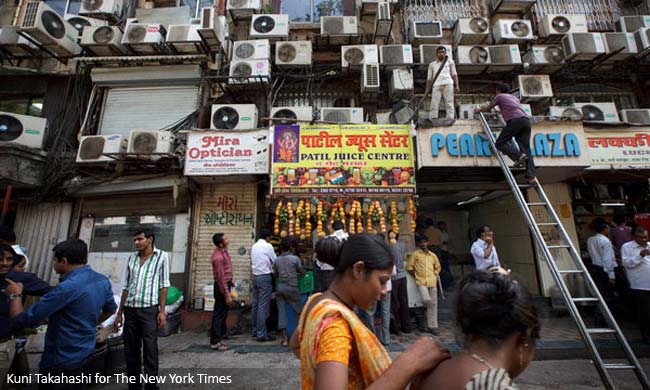
In the ramshackle apartment blocks and sooty
concrete homes that line the dusty roads of urban India, there is a new status
symbol on proud display. An air-conditioner has become a sign of middle-class
status in developing nations, a must-have dowry item.
It is cheaper than
a car, and arguably more life-changing in steamy regions, where cooling can make
it easier for a child to study or a worker to sleep.
But as air-conditioners sprout from windows
and storefronts across the world, scientists are becoming increasingly alarmed
about the impact of the gases on which they run. All are potent agents of global
warming.
Air-conditioning sales are growing 20 percent a year in China
and India, as middle classes grow, units become more affordable and temperatures
rise with climate change. The potential cooling demands of upwardly mobile
Mumbai, India, alone have been estimated to be a quarter of those of the United
States.
Air-conditioning gases are regulated primarily though a 1987
treaty called the Montreal Protocol, created to protect the ozone layer. It has
reduced damage to that vital shield, which blocks cancer-causing ultraviolet
rays, by mandating the use of progressively more benign gases. The oldest CFC
coolants, which are highly damaging to the ozone layer, have been largely
eliminated from use; and the newest ones, used widely in industrialized nations,
have little or no effect on it.
But these gases have an impact the ozone
treaty largely ignores. Pound for pound, they contribute to global warming
thousands of times more than does carbon dioxide, the standard greenhouse gas.
The leading scientists in the field have just calculated that if all the
equipment entering the world market uses the newest gases currently employed in
air-conditioners, up to 27 percent of all global warming will be attributable to
those gases by 2050.
So the therapy to cure one global environmental
disaster is now seeding another. "There is precious little time to do something,
to act," said Stephen O. Andersen, the co-chairman of the treaty's technical and
economic advisory panel.
The numbers are all moving in the wrong
direction.
Atmospheric concentrations of the gases that replaced CFCs,
known as HCFCs, which are mildly damaging to the ozone, are still rising rapidly
at a time when many scientists anticipated they should have been falling as the
treaty is phasing them out. The levels of these gases, the mainstay of booming
air-conditioning sectors in the developing world, have more than doubled in the
past two decades to record highs, according to the National Oceanic and
Atmospheric Administration.
And concentrations of the newer,
ozone-friendly gases are also rising meteorically, because industrialized
countries began switching to them a decade ago. New room air-conditioners in the
United States now use an HFC coolant called 410a, labeled "environmentally
friendly" because it spares the ozone. But its warming effect is 2,100 times
that of carbon dioxide. And the treaty cannot control the rise of these coolants
because it regulates only ozone-depleting gases.
The treaty timetable
requires dozens of developing countries, including China and India, to also
begin switching next year from HCFCs to gases with less impact on the ozone. But
the United States and other wealthy nations are prodding them to choose ones
that do not warm the planet. This week in Rio de Janeiro, Secretary of State
Hillary Rodham Clinton is attending the United Nations Conference on Sustainable
Development, also known as Rio+20, where proposals to gradually eliminate HFCs
for their warming effect are on the provisional agenda.
But she faces
resistance because the United States is essentially telling the other nations to
do what it has not: to leapfrog this generation of coolants. The trouble is,
there are currently no readily available commercial ozone-friendly alternatives
for air-conditioners that do not also have a strong warming effect - though
there are many on the horizon.
Nearly all chemical and air-conditioning
companies - including DuPont, the American chemical giant, and Daiken, one of
Japan's leading appliance manufacturers - have developed air-conditioning
appliances and gases that do not contribute to global warming. Companies have
even erected factories to produce them.
But these products require
regulatory approvals before they can be sold, and the development of new safety
standards, because the gases in them are often flammable or toxic. And with
profits booming from current cooling systems and no effective regulation of
HFCs, there is little incentive for countries or companies to move the new
designs to market.
"There are no good solutions right now - that's why
countries are grappling, tapping in the dark," said Rajendra Shende, the
recently retired head of the Paris-based United Nations ozone program, who now
runs the Terre Policy Center in Pune, India.
An Unanticipated Problem
The 25-year-old Montreal Protocol is widely regarded as the most
successful environmental treaty ever, essentially eliminating the use of CFC
coolants, which are highly damaging to the ozone layer. Under its terms,
wealthier countries shift away from each harmful gas first, and developing
countries follow a decade or more later so that replacement technologies can be
perfected and fall in price.
Concentrations of CFC-12, which had been
growing rapidly since the 1960s, have tapered off since 2003, thanks to the
treaty's strict phaseout schedule. In 2006, NASA scientists concluded that the
ozone layer was on the mend.
But that sense of victory has been eclipsed
by the potentially disastrous growth in emissions from the newer
air-conditioning gases. While a healthier ozone layer itself leads to some
warming, far more warming results from the tendency of these coolant gases to
reflect back heat radiating off the Earth.
When the treaty set its rules
in the mid-1980s, global warming was poorly understood, the cooling industry was
anchored in the West, and demand for cooling was minuscule in developing
nations.
That has clearly changed.
Jayshree Punjabi, a
40-year-old from Surat, was shopping for an air-conditioner at Vijay Sales in
Mumbai on a recent afternoon. She bought her first one 10 years ago and now has
three. "Now almost every home in Surat has more than one," she said. "The
children see them on television and demand them."
Refrigeration is also
essential for these countries' shifting food supplies. "When I was a kid in
Delhi, veggies came from vendors on the street; now they all come from the
supermarket," said Atul Bagai, an Indian citizen who is the United Nations ozone
program's coordinator for South Asia.
In 2011, 55 percent of new
air-conditioning units were sold in the Asia Pacific region, and the industry's
production has moved there. Last year, China built more than 70 percent of the
world's household air-conditioners, for domestic use and export. The most common
coolant gas is HCFC-22. In 2010, China produced about seven times the amount of
that gas as the United States.
With inexpensive HCFC-22 from Asia
flooding the market, efforts to curb or eliminate its use have been undercut,
even in the United States. For example, although American law now forbids the
sale of new air-conditioners containing HCFC, stores have started selling empty
components that can be filled with the cheap gas after installation, enabling
its continued use.
Trying to Adapt the Treaty
During a
four-day meeting in Montreal in April, about 200 representatives attending the
protocol's executive committee meeting clashed over how to adapt to the changing
circumstances. Should they be concerned with ozone protection, climate change or
both?
As developing countries submitted plans to reduce reliance on
HCFCs in order to win United Nations financing for the transition, delegations
from richer nations rejected proposals that relied on HFCs, because of their
warming effect. Canada raised a proposal that countries should use only
compounds with low impact on global warming.
Phasing out HFCs by
incorporating them into the treaty is one of the most cost-effective ways to
reduce global warming, said Durwood Zaelke, president of the Institute for
Governance and Sustainable Development.
But India, China and Brazil
object that this could slow development and cost too much. All the acceptable
substitutes under development for air-conditioners are either under patent,
demand new equipment or require extensive new regulation and testing procedures.
"This appears simple, but it's not standard, and it imposes a new burden," said
Wang Yong, of the Chinese delegation.
Said Suely Carvalho, the
Brazilian-born chief of the United Nations Development Program's Montreal
Protocol and Chemicals Unit: "The developing countries are already struggling to
phase out, and now you tell them, 'Don't do what we did.' You can see why
they're upset."
Commercial interests foster the stalemate. Though the
protocol aggressively reduces the use of HCFC-22 for cooling, it restricts
production on a slower, more lenient timetable, and as a result, output has
grown more than 60 percent in the past decade. Even in the United States,
HCFC-22 is still profitably manufactured for use in older appliances, export and
a few other industrial purposes that do not create significant emissions, like
making Teflon.
Politically influential manufacturers like Gujarat
Fluorochemicals in India, Zhejiang Dongyang Chemical Company in China and
Quimbasicos in Mexico (of which Honeywell owns 49 percent) have prospered by
producing the coolant. They even receive lucrative subsidies from the United
Nations for making it.
For their part, manufacturers are reluctant to
hurry to market new technologies that are better for the climate, until they get
a stronger signal of which ones countries will adopt, said Mack McFarland, an
atmospheric scientist with DuPont.
Othmar Schwank, a Swiss environmental
consultant who has advised the United Nations, said: "In many countries, these
targets will be very difficult to achieve. With appliances growing in India and
China, everyone is making money, so they want to delay this as much as
possible."
Technologies Stalled
The Montreal Protocol
originally gave the developing countries until 2040 to get rid of HCFCs, but its
governing board accelerated that timetable in 2007. "We saw consumption going
through the roof," said Markus Wypior, of the German government agency GIZ
Proklima. The new schedule says developing countries must "stabilize"
consumption of HCFCs by Jan. 1, and reduce it by 10 percent by 2015.
But
the industry is growing so fast that meeting the targets, which were based on
consumption in 2009-10, would now require a 40 percent reduction from current
use in India. Many countries, including India, are trying to satisfy their 2013
mandate with one-time fixes that do not involve the cooling sector - for
example, replacing HCFC-22 with another gas in making foam. Meeting the next
reduction target, in 2015, is expected to be much harder.
In the
meantime, the Montreal Protocol has started using its limited tools to prod
developing countries moving from HCFCs toward climate-friendly solutions,
offering a 25 percent bonus payment for plans that create less warming. Experts
say that is not sufficient incentive for the drastic changes needed in machine
design, servicing, manufacturing and regulation.
Promising technologies
wait, stalled in the wings. In China and a few other countries, room
air-conditioners using hydrocarbons - which cause little warming or ozone
depletion - are already coming off assembly lines in small numbers but have not
yet been approved for sale, in part because the chemicals are flammable.
Yet in Europe, refrigerators that cool with hydrocarbons have been in
use for years, and some companies in the United States, like Pepsi and Ben and
Jerry's, have recently converted in-store coolers from HFCs to hydrocarbons as
part of sustainability plans.
In a statement, the United States
Environmental Protection Agency said it had recently approved some of the new
climate-friendly gases for car air-conditioning and refrigerators and is
"evaluating additional alternatives for other air-conditioning applications,"
most notably a newer HFC variant called R32.
But when will they be on
the market? Even small steps forward have been frustrated.
Last year the
European Union began requiring automakers to use climate-friendly coolants in
cars, considered a relatively simple transition. A chemical called 1234yf was
deemed suitable, and the tiny amounts of coolant in car air-conditioners make
flammability and high cost less of a deterrent.
But this year, the
European Union postponed the plan: Chinese factories that make the compound are
still in the process of obtaining government registration. The patent, owned by
Honeywell, is being disputed. And the German government has still not finished
safety testing.
Said Mr. Wypior, whose agency is trying to promote
climate-friendly air-conditioning industries in India and China: "The
technologies are available. They're well known. They're proven - though not at
scale. So why aren't we moving?"
In the ramshackle apartment blocks and sooty concrete homes that line the dusty roads of urban India, there is a new status symbol on proud display. An air-conditioner has become a sign of middle-class status in developing nations, a must-have dowry item.
It is cheaper than a car, and arguably more life-changing in steamy regions, where cooling can make it easier for a child to study or a worker to sleep.
Air-conditioning sales are growing 20 percent a year in China and India, as middle classes grow, units become more affordable and temperatures rise with climate change. The potential cooling demands of upwardly mobile Mumbai, India, alone have been estimated to be a quarter of those of the United States.
Air-conditioning gases are regulated primarily though a 1987 treaty called the Montreal Protocol, created to protect the ozone layer. It has reduced damage to that vital shield, which blocks cancer-causing ultraviolet rays, by mandating the use of progressively more benign gases. The oldest CFC coolants, which are highly damaging to the ozone layer, have been largely eliminated from use; and the newest ones, used widely in industrialized nations, have little or no effect on it.
But these gases have an impact the ozone treaty largely ignores. Pound for pound, they contribute to global warming thousands of times more than does carbon dioxide, the standard greenhouse gas.
The leading scientists in the field have just calculated that if all the equipment entering the world market uses the newest gases currently employed in air-conditioners, up to 27 percent of all global warming will be attributable to those gases by 2050.
So the therapy to cure one global environmental disaster is now seeding another. "There is precious little time to do something, to act," said Stephen O. Andersen, the co-chairman of the treaty's technical and economic advisory panel.
The numbers are all moving in the wrong direction.
Atmospheric concentrations of the gases that replaced CFCs, known as HCFCs, which are mildly damaging to the ozone, are still rising rapidly at a time when many scientists anticipated they should have been falling as the treaty is phasing them out. The levels of these gases, the mainstay of booming air-conditioning sectors in the developing world, have more than doubled in the past two decades to record highs, according to the National Oceanic and Atmospheric Administration.
And concentrations of the newer, ozone-friendly gases are also rising meteorically, because industrialized countries began switching to them a decade ago. New room air-conditioners in the United States now use an HFC coolant called 410a, labeled "environmentally friendly" because it spares the ozone. But its warming effect is 2,100 times that of carbon dioxide. And the treaty cannot control the rise of these coolants because it regulates only ozone-depleting gases.
The treaty timetable requires dozens of developing countries, including China and India, to also begin switching next year from HCFCs to gases with less impact on the ozone. But the United States and other wealthy nations are prodding them to choose ones that do not warm the planet. This week in Rio de Janeiro, Secretary of State Hillary Rodham Clinton is attending the United Nations Conference on Sustainable Development, also known as Rio+20, where proposals to gradually eliminate HFCs for their warming effect are on the provisional agenda.
But she faces resistance because the United States is essentially telling the other nations to do what it has not: to leapfrog this generation of coolants. The trouble is, there are currently no readily available commercial ozone-friendly alternatives for air-conditioners that do not also have a strong warming effect - though there are many on the horizon.
Nearly all chemical and air-conditioning companies - including DuPont, the American chemical giant, and Daiken, one of Japan's leading appliance manufacturers - have developed air-conditioning appliances and gases that do not contribute to global warming. Companies have even erected factories to produce them.
But these products require regulatory approvals before they can be sold, and the development of new safety standards, because the gases in them are often flammable or toxic. And with profits booming from current cooling systems and no effective regulation of HFCs, there is little incentive for countries or companies to move the new designs to market.
"There are no good solutions right now - that's why countries are grappling, tapping in the dark," said Rajendra Shende, the recently retired head of the Paris-based United Nations ozone program, who now runs the Terre Policy Center in Pune, India.
An Unanticipated Problem
The 25-year-old Montreal Protocol is widely regarded as the most successful environmental treaty ever, essentially eliminating the use of CFC coolants, which are highly damaging to the ozone layer. Under its terms, wealthier countries shift away from each harmful gas first, and developing countries follow a decade or more later so that replacement technologies can be perfected and fall in price.
Concentrations of CFC-12, which had been growing rapidly since the 1960s, have tapered off since 2003, thanks to the treaty's strict phaseout schedule. In 2006, NASA scientists concluded that the ozone layer was on the mend.
But that sense of victory has been eclipsed by the potentially disastrous growth in emissions from the newer air-conditioning gases. While a healthier ozone layer itself leads to some warming, far more warming results from the tendency of these coolant gases to reflect back heat radiating off the Earth.
When the treaty set its rules in the mid-1980s, global warming was poorly understood, the cooling industry was anchored in the West, and demand for cooling was minuscule in developing nations.
That has clearly changed.
Jayshree Punjabi, a 40-year-old from Surat, was shopping for an air-conditioner at Vijay Sales in Mumbai on a recent afternoon. She bought her first one 10 years ago and now has three. "Now almost every home in Surat has more than one," she said. "The children see them on television and demand them."
Refrigeration is also essential for these countries' shifting food supplies. "When I was a kid in Delhi, veggies came from vendors on the street; now they all come from the supermarket," said Atul Bagai, an Indian citizen who is the United Nations ozone program's coordinator for South Asia.
In 2011, 55 percent of new air-conditioning units were sold in the Asia Pacific region, and the industry's production has moved there. Last year, China built more than 70 percent of the world's household air-conditioners, for domestic use and export. The most common coolant gas is HCFC-22. In 2010, China produced about seven times the amount of that gas as the United States.
With inexpensive HCFC-22 from Asia flooding the market, efforts to curb or eliminate its use have been undercut, even in the United States. For example, although American law now forbids the sale of new air-conditioners containing HCFC, stores have started selling empty components that can be filled with the cheap gas after installation, enabling its continued use.
Trying to Adapt the Treaty
During a four-day meeting in Montreal in April, about 200 representatives attending the protocol's executive committee meeting clashed over how to adapt to the changing circumstances. Should they be concerned with ozone protection, climate change or both?
As developing countries submitted plans to reduce reliance on HCFCs in order to win United Nations financing for the transition, delegations from richer nations rejected proposals that relied on HFCs, because of their warming effect. Canada raised a proposal that countries should use only compounds with low impact on global warming.
Phasing out HFCs by incorporating them into the treaty is one of the most cost-effective ways to reduce global warming, said Durwood Zaelke, president of the Institute for Governance and Sustainable Development.
But India, China and Brazil object that this could slow development and cost too much. All the acceptable substitutes under development for air-conditioners are either under patent, demand new equipment or require extensive new regulation and testing procedures. "This appears simple, but it's not standard, and it imposes a new burden," said Wang Yong, of the Chinese delegation.
Said Suely Carvalho, the Brazilian-born chief of the United Nations Development Program's Montreal Protocol and Chemicals Unit: "The developing countries are already struggling to phase out, and now you tell them, 'Don't do what we did.' You can see why they're upset."
Commercial interests foster the stalemate. Though the protocol aggressively reduces the use of HCFC-22 for cooling, it restricts production on a slower, more lenient timetable, and as a result, output has grown more than 60 percent in the past decade. Even in the United States, HCFC-22 is still profitably manufactured for use in older appliances, export and a few other industrial purposes that do not create significant emissions, like making Teflon.
Politically influential manufacturers like Gujarat Fluorochemicals in India, Zhejiang Dongyang Chemical Company in China and Quimbasicos in Mexico (of which Honeywell owns 49 percent) have prospered by producing the coolant. They even receive lucrative subsidies from the United Nations for making it.
For their part, manufacturers are reluctant to hurry to market new technologies that are better for the climate, until they get a stronger signal of which ones countries will adopt, said Mack McFarland, an atmospheric scientist with DuPont.
Othmar Schwank, a Swiss environmental consultant who has advised the United Nations, said: "In many countries, these targets will be very difficult to achieve. With appliances growing in India and China, everyone is making money, so they want to delay this as much as possible."
Technologies Stalled
The Montreal Protocol originally gave the developing countries until 2040 to get rid of HCFCs, but its governing board accelerated that timetable in 2007. "We saw consumption going through the roof," said Markus Wypior, of the German government agency GIZ Proklima. The new schedule says developing countries must "stabilize" consumption of HCFCs by Jan. 1, and reduce it by 10 percent by 2015.
But the industry is growing so fast that meeting the targets, which were based on consumption in 2009-10, would now require a 40 percent reduction from current use in India. Many countries, including India, are trying to satisfy their 2013 mandate with one-time fixes that do not involve the cooling sector - for example, replacing HCFC-22 with another gas in making foam. Meeting the next reduction target, in 2015, is expected to be much harder.
In the meantime, the Montreal Protocol has started using its limited tools to prod developing countries moving from HCFCs toward climate-friendly solutions, offering a 25 percent bonus payment for plans that create less warming. Experts say that is not sufficient incentive for the drastic changes needed in machine design, servicing, manufacturing and regulation.
Promising technologies wait, stalled in the wings. In China and a few other countries, room air-conditioners using hydrocarbons - which cause little warming or ozone depletion - are already coming off assembly lines in small numbers but have not yet been approved for sale, in part because the chemicals are flammable.
Yet in Europe, refrigerators that cool with hydrocarbons have been in use for years, and some companies in the United States, like Pepsi and Ben and Jerry's, have recently converted in-store coolers from HFCs to hydrocarbons as part of sustainability plans.
In a statement, the United States Environmental Protection Agency said it had recently approved some of the new climate-friendly gases for car air-conditioning and refrigerators and is "evaluating additional alternatives for other air-conditioning applications," most notably a newer HFC variant called R32.
But when will they be on the market? Even small steps forward have been frustrated.
Last year the European Union began requiring automakers to use climate-friendly coolants in cars, considered a relatively simple transition. A chemical called 1234yf was deemed suitable, and the tiny amounts of coolant in car air-conditioners make flammability and high cost less of a deterrent.
But this year, the European Union postponed the plan: Chinese factories that make the compound are still in the process of obtaining government registration. The patent, owned by Honeywell, is being disputed. And the German government has still not finished safety testing.
Said Mr. Wypior, whose agency is trying to promote climate-friendly air-conditioning industries in India and China: "The technologies are available. They're well known. They're proven - though not at scale. So why aren't we moving?"
______________________________
http://www.thehindu.com/opinion/columns/sainath/article3595351.ece?css=print
Farm suicides rise in Maharashtra ,
State still leads the list

It
accounted for well over a fifth of the total of 14,027 deaths in 2011
With a figure of at least 14,027 in 2011, according to the National Crime
Records Bureau (NCRB), the total number of farm suicides since 1995 has touched
2,70, 940. The State of Maharashtra Maharashtra
remains the worst single State for farm suicides for over a decade now.
The total number of farmers who have taken their own lives in Maharashtra since 1995 is closing in on 54,000. Of these
33,752 have occurred in nine years since 2003, at an annual average of 3,750.
The figure for 1995-2002 was 20,066 at an average of 2,508. Significantly, the
rise is occurring even as the farm population is shrinking a fact broadly true
across the country. And more so in Maharashtra
which has been urbanising more rapidly than most. The
rising-suicides-shrinking-population equation suggests a major intensification
of the pressures on the community. A better understanding of that, though,
awaits the new farm population figures of the 2011 Census — not expected for
many months from now. At present both national and State-wise farm suicide ratios
(the number of farmers committing suicide per 100,000 farmers) are based on
very outdated 2001 Census numbers.
Big five States
The 2011 total gets dicey with Chhattisgarh’s posting a figure of zero farm
suicides. A zero figure should be great news. Except that Chhattisgarh had
7,777 farm suicides in the preceding five years, including 1,126 in 2010. It
has been amongst the very worst States for such deaths for several years. The
share of the worst (Big 5) states (Maharashtra ,
Karnataka, Andhra Pradesh, Chhattisgarh and Madhya Pradesh) as a percentage of
total farm suicides, is now around 64 per cent. Even with Chhattisgarh showing
a ‘zero’ figure, that is not much lower than the preceding five-year average
for the Big 5 of close to 66 per cent. It could be that Chhattisgarh’s figures
have simply not made it to the NCRB in time. Otherwise, it means that the State
is in fact a late entrant to the numbers massage parlour. Others have been
doing it for years. Maharashtra since 2007,
following the Prime Minister’s visit to Vidarbha. Union Minister for
Agriculture Sharad Pawar has strictly avoided using NCRB farm data in
Parliament since 2008 because the data are unpleasant. (The union government
however quotes the NCRB for all other categories). Now, governments are deep
into fiddling the data that goes from the States to the NCRB.
With the Big 5 also staring drought in the face, what numbers the coming
season will throw up is most worrying. Within Maharashtra ,
Vidarbha and Marathwada have already been under great stress (which in turn
pushes officials to step up data fiddles). If the numbers are re-calculated
using the annual average of Chhattisgarh in the past five years, the national
total of farm suicides for 2011 would be 15,582. And the share of the Big 5 (at
10,524) would be nearly 68 per cent. That’s higher than the five-year average
for those States, too. In 1995, the first time the NCRB tabulated farm suicide
data, the Big 5 accounted for 56.04 per cent of all farm suicides.
In 2011, five States showed increases of over 50 farm suicides compared to
2010. These included Gujarat (55), Haryana
(87), Madhya Pradesh (89), Tamil Nadu (82). Maharashtra
alone showed a rise of 196. Nine States showed declines exceeding 50 farm
suicides, of which Karnataka (485) and Andhra Pradesh (319) and West Bengal (186) claimed the biggest falls. That, of
course, after Chhattisgarh, which claimed a decline of 1,126, with its zero
farm suicides figure in 2011.
_______________________
http://www.thehindu.com/sci-tech/science/article3603258.ece?css=print
"This is just the beginning of a long journey"
“As a layman, we
have it,” is what Rolf Heur, Director-General of CERN, said at the end of the
seminar
Yes. The long-sought Higgs boson, dubbed by lay media as ‘God Particle’
much to the dislike and discomfiture of scientists, may have been discovered.
This essentially was the take home message of the much publicised and keenly
awaited seminar on Wednesday at CERN, the Geneva-based European Centre for
Nuclear Research. CERN houses the huge underground 27 km-long ringed particle
accelerator called the Large Hadron Collider (LHC) with the search for the
Higgs particle as one of its main goals.
The Higgs boson, hypothesised in the 1960s by three groups of scientists
(Peter Higgs and five others) independently, is the crucial missing piece in an
otherwise enormously successful theoretical framework called the Standard Model
which accurately describes the fundamental particles and forces of nature. The
masses of fundamental particles of nature are determined by the strengths of
their interaction with Higgs. Without the Higgs particle matter in the universe
will have no mass. So its existence is a vital cornerstone for describing the
universe correctly.
For the lay public at large, the uncertainty signified by the use of ‘may’
above does not really matter as it arises purely from technical considerations.
The two key experiments at the LHC – CMS and ATLAS – designed to look for the
hypothesised Higgs particle have found unambiguous signals for the observation
of a new boson. This new particle waddles like a Higgs and quacks like a Higgs.
But is it the Higgs particle of the Standard Model that scientists have been
searching for the last nearly four decades? At this point of time, however, LHC
scientists would like to duck the question. They would like to ascertain other
characteristics of the new particle before definitively dubbing it as the
Standard Model Higgs.
“As a layman, we have it,” is indeed what Rolf Heur, the Director-General
of CERN, said at the end of the seminar. But more correctly, he added: “[We
have] observed a new particle consistent with a Higgs boson. There is a lot of
work ahead of us. We also now know which direction to go. This is just the
beginning of a long journey.” At the press conference that followed the
seminar, Joe Incandela, the spokesperson for the CMS experiment clearly stated:
“[Before the LHC shuts down for maintenance three months later], it would be
difficult to say definitively that it is the Standard Model Higgs.”
While the LHC is designed to accelerate protons up to 7 TeV per beam (total
collision energy of 14 TeV), since its commissioning in 2010, the beam energy
has been gradually ramped up. After operating at 7 TeV (3.5 TeV per beam) till
end-2011, it was increased to 4 TeV per beam (8 TeV of total energy) in April.
This increase in energy, along with unprecedented performance of the
accelerator, the detectors, improved techniques of analysis and the intense
computation on the worldwide LHC computational grid established, is what has
enabled this landmark finding within a short time of two and a quarter years
since LHC went into operation.
In terms of numbers, till the end of 2011, the experiments took data from
about 400 trillion proton-proton collisions at 7 TeV of total energy, when
there were already tantalising hints of a Higgs-like signal at around a mass
value of 125 G(iga) eV. (At relativistic energies, mass and energy are
interchangeable in accordance with Einstein’s E=mc2 relation. So masses of
particles are measured in units of energy. The mass of a proton is about 1
GeV.) But it was not statistically significant to call it a discovery of a
particle. The statistical significance of the bump or excess of events around
125 GeV at end-2011 was only at the level of about 3 sigma, which means
one-in-750 chance of being due to statistical fluctuation, which is far from
the ‘golden rule’ for discovery of 5 sigma, which means there is only
one-in-3.5 million chance of being wrong.
But the data taken in just 3 months (from April 5 to June 18) at 8 GeV of
collision energy — from about 500 trillion proton-proton collisions — has
surpassed the data taken in all of 2011 at 7 TeV. Moreover, the Standard Model
predicts that at 8 TeV there is an enhancement in the probability of producing
a Standard Model Higgs by a factor of 1.27, Aleandro Nisati of the ATLAS
experiment said in an email response. So if you do the arithmetic of combining
the effect of increased energy and that of higher proton-proton collision rate
because of better accelerator performance, scientists now have 2.6 more
Higgs-like events at 8 TeV for every Higgs-like event at 7 TeV in 2011.
All these have contributed to improved statistics in the data gathered, in
particular for two of the five important decay channels available to Higgs —
namely its decay into two photons and to four charged leptons (electrons/muons)
— whose data were presented on Wednesday. These channels are considered
important because these allow the Higgs mass to be measured with greater precision.
The later is, in fact, called the Golden Channel because it is much cleaner
compared to the other channels. The analysis had also been particularly
optimised to pick Higgs-like events decaying into these final states, according
to Nisati.
According to the presentations made on Wednesday by Joe Incandela and
Fabiola Gianotti, the respective spokespersons of CMS and ATLAS respectively,
both the experiments, which have worked entirely independently of each other,
observed a “new particle” in the mass region around 125 – 126 GeV at 5 sigma
level. The world physicist community had not really expected that the 5 sigma
level would be attained so quickly. Both presented results from their analyses
only of 2 photon and 4 lepton channels.
Specifically, the mass value given by CMS to this Higgs-like particle from
is 125.6 GeV with an error window of 0.6 GeV, and that given by ATLAS is 125.3
GeV with an error bar of 0.6 GeV. It is clear that both the results are
consistent with each other within experimental errors. The immediate next step
for these experiments is first to analyze data from the remaining three
channels of Higgs decay and check for consistency LHC before shuts down for
maintenance. The larger task in months ahead is to ascertain whether the other
properties of this new Higgs-like particle fit the predicted properties of the
Higgs boson or is it something entirely different.
_________________________
The process
within the LHC
At the Large Hadron
Collider (LHC), two counter-rotating beams of protons accelerated to high
energy are made to collide head-on to result in the creation of myriad
particles, known and unknown. From the debris of trillions of such collisions,
scientists look for signals characteristic of processes involving the Higgs
boson. Higgs is a very short-lived particle with a lifetime of only about
ten-thousandth of a billionth of a second. Once created, the Higgs boson will
immediately decay into several channels and experiments analyse the final
products of such decays and see if these really came from the decay of a Higgs
boson.
What makes this task
really tough is to be able to pick the right events from a large background of
other processes from known physics that mimic the decay of Higgs.
A signal for Higgs
means that, in a plot of events observed, a bump sticks out above the large
background from other mimicking processes. But such excess of events should be
statistically significant to be ascribed to a new entity such as Higgs.
That is, the bump
should not be explainable by statistical fluctuation in the background if there
were no Higgs, and it is indeed due to processes involving Higgs. Statistical
significance is measured in terms of what is called standard deviation (called
sigma).
For any discovery in
particle physics, the signal should be at least at ‘5 sigma level’ over the
background, which is equivalent to one in 3.5 million chance of the bump being
due to statistical fluctuation.
_______________________________
Punjab ’s new challenge: uranium in ground water
Even as he accepted
Punjab’s case for enhanced allocation to augment the rural water supply system,
as it faces the problem of presence of uranium, arsenic, and heavy metals in
ground water used for drinking, Union Rural Development and Panchayats Minister
Jairam Ramesh on Friday advised the State government to introspect and analyse
its performance record on utilisation of previous grants for the purpose.
Laboratory
Mr. Ramesh was talking to reporters after laying the foundation for a
one-of-its-kind laboratory in Mohali, which would be dedicated to testing
drinking water.
The Rs. 4-crore facility would cater to the needs of the northern States.
The Bhabha Atomic Research Centre would coordinate with the laboratory to
assess the presence of heavy metals and hazardous materials in drinking water.
It would analyse the causes, besides suggesting remedies and viable
alternatives to deal with the situation, the Minister said.
Ever since some environmentalist raised the issue, water from 2462
tubewells was collected from across Punjab . Of
the 1642 results available so far, at least 1142 tested positive for presence
of uranium.
While most of the water was from the cotton belt in the south-western
districts of the Malwa region of Punjab ,
Gurdaspur from the Majha belt reported the presence of arsenic in ground water.
Mr. Ramesh said that though the exact cause could not be pinpointed
immediately, the most popular theory doing the rounds indicated that the heavy
metals could have leached into the soil from the excessive use of
phosphate-based fertilizers.
Presiding over a regional review meeting on drinking water supply and
sanitation, in which representatives from most north Indian States participated,
Mr. Ramesh revealed that Rs. 10, 500 crore would be spent in the current fiscal
to provide clean drinking water in rural areas.
At least Rs. 525 crore was earmarked for areas where ground water had
unique issues, like uranium in Punjab .
Mr. Ramesh said the allocation for rural water supply schemes in different
States in the North had been increased substantially compared to last year.
Jammu and Kashmir would get Rs. 511 crore this year, against Rs. 435 crore the
previous year; Uttrakhand Rs. 160 crore, compared to Rs. 139 crore last year;
Haryana, Rs. 250 crore, compared to Rs. 211 crore. However, Punjab
would get Rs. 103 crore in 2012-13, compared to just Rs. 88 crore last fiscal.
Seeking to deny any discrimination, Mr. Ramesh said Punjab
had to introspect on its priorities. Of Rs. 151 crore provided through central
grants for rural water supply so far, Punjab
could utilise only Rs. 29 crore.
Similarly, while the rest of the States made major strides in sanitation, Punjab lagged behind. He pointed out that by providing
toilets to all, Sikkim
By November, Kerala was expected to clock 100 per cent coverage under the
Nirmal gram scheme of providing sanitation.
Haryana and Himachal Pradesh were expected to be declared “Nirmal Raj” in
2013. But Punjab , which reported just 2 per
cent coverage, required at least four years for guaranteeing provision of
sanitation facilities to 100 per cent of the population.
_______________________
http://www.i4u.com/2012/07/onslaught-making-us-crazy
Is the Onslaught Making Us Crazy?
Is the Web Driving Us Mad?
The new research into the Net’s negative effects. By Tony Dokoupil.
|
Before he launched the most viral video in Internet history, Jason
Russell was a half-hearted Web presence. His YouTube account was dead, and
his Facebook and Twitter pages were a trickle of kid pictures and home-garden
updates. The Web wasn’t made “to keep track of how much people like us,” he
thought, and when his own tech habits made him feel like “a genius, an addict,
or a megalomaniac,” he unplugged for days, believing, as the humorist Andy
Borowitz put it in a tweet that Russell tagged as a favorite, “it’s important to
turn off our computers and do things in the real world.”
But this past March Russell struggled to turn off anything. He forwarded a
link to “Kony 2012,” his deeply personal Web documentary about the African warlord Joseph
Kony. The idea was to use social media to make Kony famous as the first step
to stopping his crimes. And it seemed to work: the film hurtled through
cyberspace, clocking more than 70 million views in less than a week. But
something happened to Russell in the process. The same digital tools that
supported his mission seemed to tear at his psyche, exposing him to nonstop
kudos and criticisms, and ending his arm’s-length relationship with new
media.
He slept two hours in the first four days, producing a swirl of bizarre
Twitter updates. He sent a link to “I Met the Walrus,” a short animated
interview with John Lennon, urging followers to “start training your mind.” He
sent a picture of his tattoo, TIMSHEL, a biblical word about man’s choice
between good and evil. At one point he uploaded and commented on a digital photo
of a text message from his mother. At another he compared his life to the
mind-bending movie Inception, “a dream inside a dream.”
On the eighth day of his strange, 21st-century vortex, he sent a final
tweet—a quote from Martin Luther King Jr.: “If you can’t fly, then run, if you
can’t run, then walk, if you can’t walk, then crawl, but whatever you do, you
have to keep moving forward”—and walked back into the real world. He took off
his clothes and went to the corner of a busy intersection near his home in San
Diego, where he repeatedly slapped the concrete with both palms and ranted about
the devil. This too became a viral video.
Afterward Russell was diagnosed with “reactive psychosis,” a form of
temporary insanity. It had nothing to do with drugs or alcohol, his wife,
Danica, stressed in a blog post, and everything to do with the machine that kept
Russell connected even as he was breaking apart. “Though new to us,” Danica
continued, “doctors say this is a common experience,” given Russell’s “sudden
transition from relative anonymity to worldwide attention—both raves and
ridicules.” More than four months later, Jason is out of the hospital, his
company says, but he is still in recovery. His wife took a “month of silence” on
Twitter. Jason’s social-media accounts remain dark.
Questions about the Internet’s deleterious effects on the mind are at least
as old as hyperlinks. But even among Web skeptics, the idea that a new
technology might influence how we think and feel—let alone contribute to a great
American crack-up—was considered silly and naive, like waving a cane at electric
light or blaming the television for kids these days. Instead, the Internet was
seen as just another medium, a delivery system, not a diabolical machine. It
made people happier and more productive. And where was the proof
otherwise?
Now, however, the proof is starting to pile up. The first good, peer-reviewed
research is emerging, and the picture is much gloomier than the trumpet blasts
of Web utopians have allowed. The current incarnation of the Internet—portable,
social, accelerated, and all-pervasive—may be making us not just dumber or
lonelier but more depressed and anxious, prone to obsessive-compulsive and
attention-deficit disorders, even outright psychotic. Our digitized minds can
scan like those of drug addicts, and normal people are breaking down in sad and
seemingly new ways.
In the summer of 1996, seven young researchers at MIT blurred the lines
between man and computer, living simultaneously in the physical and virtual
worlds. They carried keyboards in their pockets, radio-transmitters in their
backpacks, and a clip-on screen in front of their eyes. They called themselves
“cyborgs”—and they were freaks. But as Sherry Turkle, a psychologist at MIT,
points out, “we are all cyborgs now.” This life of continuous connection has
come to seem normal, but that’s not the same as saying that it’s healthy or
sustainable, as technology—to paraphrase the old line about alcohol—becomes the
cause of and solution to of all life’s problems.
In less than the span of a single childhood, Americans have merged with their
machines, staring at a screen for at least eight hours a day, more time than we
spend on any other activity including sleeping. Teens fit some seven hours of
screen time into the average school day; 11, if you count time spent
multitasking on several devices. When President Obama last ran for office, the
iPhone had yet to be launched. Now smartphones outnumber the old models in
America, and more than a third of users get online before getting out of
bed.
Meanwhile, texting has become like blinking: the average person, regardless
of age, sends or receives about 400 texts a month, four times the 2007 number.
The average teen processes an astounding 3,700 texts a month, double the 2007
figure. And more than two thirds of these normal, everyday cyborgs, myself
included, report feeling their phone vibrate when in fact nothing is happening.
Researchers call it “phantom-vibration syndrome.”

Altogether the digital shifts of the last five years call to mind a horse
that has sprinted out from underneath its rider, dragging the person who once
held the reins. No one is arguing for some kind of Amish future. But the
research is now making it clear that the Internet is not “just” another delivery
system. It is creating a whole new mental environment, a digital state of nature
where the human mind becomes a spinning instrument panel, and few people will
survive unscathed.
“This is an issue as important and unprecedented as climate change,” says
Susan Greenfield, a pharmacology professor at Oxford University who is working
on a book about how digital culture is rewiring us—and not for the better. “We
could create the most wonderful world for our kids but that’s not going to
happen if we’re in denial and people sleepwalk into these technologies and end
up glassy-eyed zombies.”
Does the Internet make us crazy? Not the technology itself or the content,
no. But a Newsweek review of findings from more than a dozen countries finds the
answers pointing in a similar direction. Peter Whybrow, the director of the
Semel Institute for Neuroscience and Human Behavior at UCLA, argues that “the
computer is like electronic cocaine,” fueling cycles of mania followed by
depressive stretches. The Internet “leads to behavior that people are conscious
is not in their best interest and does leave them anxious and does make them act
compulsively,” says Nicholas Carr, whose book The Shallows, about the
Web’s effect on cognition, was nominated for a Pulitzer Prize. It “fosters our
obsessions, dependence, and stress reactions,” adds Larry Rosen, a California
psychologist who has researched the Net’s effect for decades. It “encourages—and
even promotes—insanity.”
Fear that the Internet and mobile technology contributes to addiction—not to
mention the often related ADHD and OCD disorders—has persisted for decades, but
for most of that time the naysayers prevailed, often puckishly. “What’s next?
Microwave abuse and Chapstick addiction?” wrote a peer reviewer for one of the
leading psychiatric journals, rejecting a national study of problematic Internet
use in 2006. The Diagnostic and Statistical Manual of Mental Disorders has never
included a category of machine-human interactions.
But that view is suddenly on the outs. When the new DSM is released next
year, Internet Addiction Disorder will be included for the first time, albeit in
an appendix tagged for “further study.” China, Taiwan, and Korea recently
accepted the diagnosis, and began treating problematic Web use as a grave
national health crisis. In those countries, where tens of millions of people
(and as much as 30 percent of teens) are considered Internet-addicted, mostly to
gaming, virtual reality, and social media, the story is sensational front-page
news. One young couple neglected its infant to death while nourishing a virtual
baby online. A young man fatally bludgeoned his mother for suggesting he log off
(and then used her credit card to rack up more hours). At least 10 ultra-Web
users, serviced by one-click noodle delivery, have died of blood clots from
sitting too long.
Now the Korean government is funding treatment centers, and coordinating a
late-night Web shutdown for young people. China, meanwhile, has launched a
mothers’ crusade for safe Web habits, turning to that approach after it emerged
that some doctors were using electro-shock and severe beatings to treat
Internet-addicted teens.
“There’s just something about the medium that’s addictive,” says Elias
Aboujaoude, a psychiatrist at Stanford University School of Medicine, where he
directs the Obsessive Compulsive Disorder Clinic and Impulse Control Disorders
Clinic. “I’ve seen plenty of patients who have no history of addictive
behavior—or substance abuse of any kind—become addicted via the Internet and
these other technologies.”
His 2006 study of problematic Web habits (the one that was puckishly
rejected) was later published, forming the basis for his recent book
Virtually You, about the fallout expected from the Web’s irresistible
allure. Even among a demographic of middle-aged landline users—the average
respondent was in his 40s, white, and making more than $50,000 a year—Aboujaoude
found that more than one in eight showed at least one sign of an unhealthy
attachment to the Net. More recent surveys that recruit people already online
have found American numbers on a par with those in Asia.

Then there was the University of Maryland’s 2010 “Unplugged” experiment that
asked 200 undergrads to forgo all Web and mobile technologies for a day and to
keep a diary of their feelings. “I clearly am addicted and the dependency is
sickening,” reported one student in the study. “Media is my drug,” wrote
another. At least two other schools haven’t even been able to get such an
experiment off the ground for lack of participants. “Most college students are
not just unwilling, but functionally unable, to be without their media links to
the world,” the University of Maryland concluded.
That same year two psychiatrists in Taiwan made headlines with the idea of
iPhone addiction disorder. They documented two cases from their own practices:
one involved a high-school boy who ended up in an asylum after his iPhone usage
reached 24 hours a day. The other featured a 31-year-old saleswoman who used her
phone while driving. Both cases might have been laughed off if not for a
200-person Stanford study of iPhone habits released at the same time. It found
that one in 10 users feels “fully addicted” to his or her phone. All but 6
percent of the sample admitted some level of compulsion, while 3 percent won’t
let anyone else touch their phones.
In the two years since, concern over the Web’s pathological stickiness has
only intensified. In April, doctors told The Times of India about an
anecdotal uptick in “Facebook addiction.” The latest details of America’s Web
obsession are found in Larry Rosen’s new book, iDisorder, which, despite
the hucksterish title, comes with the imprimatur of the world’s largest academic
publisher. His team surveyed 750 people, a spread of teens and adults who
represented the Southern California census, detailing their tech habits, their
feelings about those habits, and their scores on a series of standard tests of
psychiatric disorders. He found that most respondents, with the exception of
those over the age of 50, check text messages, email or their social network
“all the time” or “every 15 minutes.” More worryingly, he also found that those
who spent more time online had more “compulsive personality traits.”
Perhaps not that surprising: those who want the most time online feel
compelled to get it. But in fact these users don’t exactly want to be so
connected. It’s not quite free choice that drives most young corporate employees
(45 and under) to keep their BlackBerrys in the bedroom within arms’ reach, per
a 2011 study; or free choice, per another 2011 study, that makes 80 percent of
vacationers bring along laptops or smartphones so they can check in with work
while away; or free choice that leads smartphone users to check their phones
before bed, in the middle of the night, if they stir, and within minutes of
waking up.
We may appear to be choosing to use this technology, but in fact we are being
dragged to it by the potential of short-term rewards. Every ping could be
social, sexual, or professional opportunity, and we get a mini-reward, a squirt
of dopamine, for answering the bell. “These rewards serve as jolts of energy
that recharge the compulsion engine, much like the frisson a gambler
receives as a new card hits the table,” MIT media scholar Judith Donath recently
told Scientific American. “Cumulatively, the effect is potent and hard to
resist.”
Recently it became possible to watch this kind of Web use rewire the brain.
In 2008 Gary Small, the head of UCLA’s Memory and Aging Research Center, was the
first to document changes in the brain as a result of even moderate Internet
use. He rounded up 24 people, half of them experienced Web users, half of them
newbies, and he passed them each through a brain scanner. The difference was
striking, with the Web users displaying fundamentally altered prefrontal
cortexes. But the real surprise was what happened next. The novices went away
for a week, and were asked to spend a total of five hours online and then return
for another scan. “The naive subjects had already rewired their brains,” he
later wrote, musing darkly about what might happen when we spend more time
online.
The brains of Internet addicts, it turns out, look like the brains of drug
and alcohol addicts. In a study published in January, Chinese researchers found
“abnormal white matter”—essentially extra nerve cells built for speed—in the
areas charged with attention, control, and executive function. A parallel study
found similar changes in the brains of videogame addicts. And both studies come
on the heels of other Chinese results that link Internet addiction to
“structural abnormalities in gray matter,” namely shrinkage of 10 to 20 percent
in the area of the brain responsible for processing of speech, memory, motor
control, emotion, sensory, and other information. And worse, the shrinkage never
stopped: the more time online, the more the brain showed signs of
“atrophy.”
While brain scans don’t reveal which came first, the abuse or the brain
changes, many clinicians feel their own observations confirmed. “There’s little
doubt we’re becoming more impulsive,” says Stanford’s Aboujaoude, and one reason
for this is technology use. He points to the rise in OCD and ADHD diagnosis, the
latter of which has risen 66 percent in the last decade. “There is a cause and
effect.”
And don’t kid yourself: the gap between an “Internet addict” and John Q.
Public is thin to nonexistent. One of the early flags for addiction was spending
more than 38 hours a week online. By that definition, we are all addicts now,
many of us by Wednesday afternoon, Tuesday if it’s a busy week. Current tests
for Internet addiction are qualitative, casting an uncomfortably wide net,
including people who admit that yes, they are restless, secretive, or
preoccupied with the Web and that they have repeatedly made unsuccessful efforts
to cut back. But if this is unhealthy, it’s clear many Americans don’t want to
be well.
Like addiction, the digital connection to depression and anxiety was also
once a near laughable assertion. A 1998 Carnegie Mellon study found that Web use
over a two-year period was linked to blue moods, loneliness, and the loss of
real-world friends. But the subjects all lived in Pittsburgh, critics sneered.
Besides, the Net might not bring you chicken soup, but it means the end of
solitude, a global village of friends, and friends you haven’t met yet. Sure
enough, when Carnegie Mellon checked back in with the denizens of Steel City a
few years later, they were happier than ever.
But the black crow is back on the wire. In the past five years, numerous
studies have duplicated the original Carnegie Mellon findings and extended them,
showing that the more a person hangs out in the global village, the worse they
are likely to feel. Web use often displaces sleep, exercise, and face-to-face
exchanges, all of which can upset even the chirpiest soul. But the digital
impact may last not only for a day or a week, but for years down the line. A
recent American study based on data from adolescent Web use in the 1990s found a
connection between time online and mood disorders in young adulthood. Chinese
researchers have similarly found “a direct effect” between heavy Net use and the
development of full-blown depression, while scholars at Case Western Reserve
University correlated heavy texting and social-media use with stress,
depression, and suicidal thinking.
In response to this work, an article in the journal Pediatrics noted
the rise of “a new phenomenon called ‘Facebook depression,’?” and explained that
“the intensity of the online world may trigger depression.” Doctors, according
to the report published by the American Academy of Pediatrics, should work
digital usage questions into every annual checkup.
Rosen, the author of iDisorder, points to a preponderance of research
showing “a link between Internet use, instant messaging, emailing, chatting, and
depression among adolescents,” as well as to the “strong relationships between
video gaming and depression.” But the problem seems to be quality as well as
quantity: bad interpersonal experiences—so common online—can lead to these
potential spirals of despair. For her book Alone Together, MIT
psychologist Sherry Turkle interviewed more than 450 people, most of them in
their teens and 20s, about their lives online. And while she’s the author of two
prior tech-positive books, and once graced the cover of Wired magazine,
she now reveals a sad, stressed-out world of people coated in Dorito dust and
locked in a dystopian relationship with their machines.
People tell her that their phones and laptops are the “place for hope” in
their lives, the “place where sweetness comes from.” Children describe mothers
and fathers unavailable in profound ways, present and yet not there at all.
“Mothers are now breastfeeding and bottle-feeding their babies as they text,”
she told the American Psychological Association last summer. “A mother made
tense by text messages is going to be experienced as tense by the child. And
that child is vulnerable to interpreting that tension as coming from within the
relationship with the mother. This is something that needs to be watched very
closely.” She added, “Technology can make us forget important things we know
about life.”
This evaporation of the genuine self also occurred among the high-school- and
college-age kids she interviewed. They were struggling with digital identities
at an age when actual identity is in flux. “What I learned in high school,” a
kid named Stan told Turkle, “was profiles, profiles, profiles; how to make a
me.” It’s a nerve-racking learning curve, a life lived entirely in public with
the webcam on, every mistake recorded and shared, mocked until something more
mockable comes along. “How long do I have to do this?” another teen sighed, as
he prepared to reply to 100 new messages on his phone.
Last year, when MTV polled its 13- to 30-year-old viewers on their Web
habits, most felt “defined” by what they put online, “exhausted” by always
having to be putting it out there, and utterly unable to look away for fear of
missing out. “FOMO,” the network called it. “I saw the best minds of my
generation destroyed by madness, starving hysterical naked,” begins Allen
Ginsberg’s poem Howl, a beatnik rant that opens with people “dragging
themselves” at dawn, searching for an “angry fix” of heroin. It’s not hard to
imagine the alternative imagery today.
The latest Net-and-depression study may be the saddest one of all. With
consent of the subjects, Missouri State University tracked the real-time Web
habits of 216 kids, 30 percent of whom showed signs of depression. The results,
published last month, found that the depressed kids were the most intense Web
users, chewing up more hours of email, chat, videogames, and file sharing. They
also opened, closed, and switched browser windows more frequently, searching,
one imagines, and not finding what they hoped to find.
They each sound like Doug, a Midwestern college student who maintained four
avatars, keeping each virtual world open on his computer, along with his school
work, email, and favorite videogames. He told Turkle that his real life is “just
another window”—and “usually not my best one.” Where is this headed? she
wonders. That’s the scariest line of inquiry of all.
Recently, scholars have begun to suggest that our digitized world may support
even more extreme forms of mental illness. At Stanford, Dr. Aboujaoude is
studying whether some digital selves should be counted as a legitimate,
pathological “alter of sorts,” like the alter egos documented in cases of
multiple personality disorder (now called dissociative identity disorder in the
DSM). To test his idea, he gave one of his patients, Richard, a mild-mannered
human-resources executive with a ruthless Web poker habit, the official test for
multiple personality disorder. The result was startling. He scored as high as
patient zero. “I might as well have been ... administering the questionnaire to
Sybil Dorsett!” Aboujaoude writes.
The Gold brothers—Joel, a psychiatrist at New York University, and Ian, a
philosopher and psychiatrist at McGill University—are investigating technology’s
potential to sever people’s ties with reality, fueling hallucinations,
delusions, and genuine psychosis, much as it seemed to do in the case of Jason
Russell, the filmmaker behind “Kony 2012.” The idea is that online life is akin
to life in the biggest city, stitched and sutured together by cables and modems,
but no less mentally real—and taxing—than New York or Hong Kong. “The data
clearly support the view that someone who lives in a big city is at higher risk
of psychosis than someone in a small town,” Ian Gold writes via email. “If the
Internet is a kind of imaginary city,” he continues. “It might have some of the
same psychological impact.”
A team of researchers at Tel Aviv University is following a similar path.
Late last year, they published what they believe are the first documented cases
of “Internet-related psychosis.” The qualities of online communication are
capable of generating “true psychotic phenomena,” the authors conclude, before
putting the medical community on warning. “The spiraling use of the Internet and
its potential involvement in psychopathology are new consequences of our
times.”
So what do we do about it? Some would say nothing, since even the best
research is tangled in the timeless conundrum of what comes first. Does the
medium break normal people with its unrelenting presence, endless distractions,
and threat of public ridicule for missteps? Or does it attract broken
souls?
But in a way, it doesn’t matter whether our digital intensity is causing
mental illness, or simply encouraging it along, as long as people are suffering.
Overwhelmed by the velocity of their lives, we turn to prescription drugs, which
helps explain why America runs on Xanax (and why rehab admissions for
benzodiazepines, the ingredient in Xanax and other anti-anxiety drugs, have
tripled since the late 1990s). We also spring for the false rescue of
multitasking, which saps attention even when the computer is off. And all of us,
since the relationship with the Internet began, have tended to accept it as is,
without much conscious thought about how we want it to be or what we want to
avoid. Those days of complacency should end. The Internet is still ours to
shape. Our minds are in the balance.
___________________________
Paul Krugman: Jul 16, 2012, 6:32 am
Who's very important? It's the 'common person'
''Is there a VIP entrance? We are VIP." That remark, by a donor waiting to get in to one of Mitt Romney's recent fundraisers in the
Specifically, these are people who believe that they are, as another Romney donor put it, "the engine of the economy"; they should be cherished, and the taxes they pay, which are already at an 80-year low, should be cut even further. Unfortunately, said yet another donor, the "common person" — for example, the "nails ladies" — just doesn't get it.
OK, it's easy to mock these people, but the joke's really on us. For the "we are VIP" crowd has fully captured the modern Republican Party, to such an extent that leading Republicans consider Romney's apparent use of multimillion-dollar offshore accounts to dodge federal taxes not just acceptable but praiseworthy: "It's really American to avoid paying taxes, legally," declared Sen. Lindsey Graham, R-S.C. And there is, of course, a good chance that Republicans will control both Congress and the White House next year.
If that happens, we'll see a sharp turn toward economic policies based on the proposition that we need to be especially solicitous toward the superrich — I'm sorry, I mean the "job creators." So it's important to understand why that's wrong.
The first thing you need to know is that
To this historical observation we should add another note: Quite a few of today's superrich, Romney included, make or made their money in the financial sector, buying and selling assets rather than building businesses in the old-fashioned sense. Indeed, the soaring share of the wealthy in national income went hand-in-hand with the explosive growth of Wall Street.
Not long ago, we were told that all this wheeling and dealing was good for everyone, that it was making the economy both more efficient and more stable. Instead, it turned out that modern finance was laying the foundation for a severe economic crisis whose fallout continues to afflict millions of Americans, and that taxpayers had to bail out many of those supposedly brilliant bankers to prevent an even worse crisis. So at least some members of the top 0.01 percent are best viewed as job destroyers rather than job creators.
Did I mention that those bailed-out bankers are now overwhelmingly backing Romney, who promises to reverse the mild financial reforms introduced after the crisis?
To be sure, many and probably most of the rich do, in fact, contribute positively to the economy. However, they also receive large monetary rewards. Yet somehow $20 million-plus in annual income isn't enough. They want to be revered, too, and given special treatment in the form of low taxes. And that is more than they deserve. After all, the "common person" also makes a positive contribution to the economy. Why single out the rich for extra praise and perks?
What about the argument that we must keep taxes on the rich low lest we remove their incentive to create wealth? The answer is that we have a lot of historical evidence, going all the way back to the 1920s, on the effects of tax increases on the rich, and none of it supports the view that the kinds of tax-rate changes for the rich currently on the table — President Barack Obama's proposal for a modest rise, Romney's call for further cuts — would have any major effect on incentives. Remember when all the usual suspects claimed that the economy would crash when Bill Clinton raised taxes in 1993?
Furthermore, if you're really concerned about the incentive effects of public policy, you should be focused not on the rich but on workers making $20,000 to $30,000 a year, who are often penalized for any gain in income because they end up losing means-tested benefits like Medicaid and food stamps. I'll have more to say about that in another column. By the way, in 2010, the average annual wage of manicurists — "nails ladies," in Romney-donor speak — was $21,760.
So, are the very rich VIP? No, they aren't — at least no more so than other working Americans. And the "common person" will be hurt, not helped, if we end up with government of the 0.01 percent, by the 0.01 percent, for the 0.01 percent.
Paul Krugman is a Nobel Prize-winning economist, a professor at
___________________________
How Editors are
managed
| |
Record Number :
A0130089
| |
Click to browse by keyword: Journalism Media Print Media newspapers Advertising Cinema Politics Elections Government/State policy/regulation
| |
How Editors are
managed
By KEWAL VARMA Editors can be broadly divided into two categories: those with substantial circulations spread over large areas of the country; and those with regional circulations. The latter, naturally, have smaller circulations, though there are exceptions (the best example being the Ananda Bazar Patrika). However, both kinds of editors have trouble with two sets of people: the Government and the managements. The views of Government and owners are not necessarily the same, but on one point most owners of publications seem to agree: that their editors should not take criticism of Government too far. And they agree on this because most owners are vulnerable: having business interests apart from news papers, they are aware that if Government wants to, it can create significant barriers between them and their profits from other factories. No one would deny the owner of a newspaper group the right to choose his editors, but at what point does this begin to hurt the fundamental duty of the Press, and how does one prevent an owner from crossing this point? No one, equally, can deny the right of a management to remove an editor but is there any recourse for an editor if he is removed on unethical grounds? The editor’s job may look glamorous, and indeed it has its rewards, but it is also one of the least protected jobs in the publishing industry. (Would it be more honest if all owners simply became the editors of their publications too? These tensions often find their worst expression when an editor has to leave. The best and most enlightened of managements have often behaved atrociously with departing editors. We think that- this subject should be discussed frankly, without prejudice to anyone, with honesty. And for this reason we have decided to name names. We would welcome it if the managements named here would reply: we will publish their rep lies equally prominently. We would be happy if SUNDAY became a vehicle for a public debate on this important, cru cial, issue. EDITORS are treated as condoms. After using them, proprietors discard them. This is the sad truth about Indian journalism. Yet, editors are the strangest species. in this animal world. They lack fellow feeling despite the common experience of humiliation they suffer at the bands of proprietors. One editor often becomes a tool -in the hands of the management to humiliate his predecessor. Last week, SUNDAY narrated how shabbily Khuswant Singh was treated by his management. But what happened to Chalapathi Rau of the National Herald, into whose shoes Khushwant Singh stepped? Few people could have been more loyal than Chalapathi Rau has been to the Nehru family for the past 40 years. Many a time, against his conscience, he stood like a rock not only by Jawaharlal Nehru but by his daughter also. The only principled line he drew was on Mr Sanjay Gandhi: he did not go- out of his way to build up the rising star of the Emergency. On his superannuation, Chalapathi Rau was rewarded for his services and made chairman of the board of editors. But the management did not show him the elementary courtesy of informing him about the appointment of Sardar Khushwant Singh as his successor. Thus was despite the fact that earlier he had acted as a cat’s paw of the company’s managing director, Yashpal Kapoor, a notorious member of the Emergency caucus, to sack a conscientious and an unassuming editor of National Herald, C. N. Chittaranjan. If Rau’s past record is any guide, there is every reason to believe that Chalapathi Rau would have gone to any length to fulfill the management’s wishes to make Sardarji a success in National Herald. But this was not to be so. He had to go. This might be excused, but how can one excuse the manner in which this was done? In the 'glorious' traditions of newspaper management, he was sent out in a most rude fashion. One day last month, Chalapathi Rau’s stenographer was on leave. As usual, he wrote his editorial. But the management gave instructions to all typists in the office to refuse to type out his editorial. Chalapathi Rau, like any other journalist, likes to see his writing in print, so he ignored the hint of the management. He sent down his handwritten manuscript to the press. But the management’s arm reaches a long way. Instructions had been sent to the press the linotype operator refused to compose the handwritten piece. The same day, when Rau was leaving office, the management did not allow him the use of the office car. The heartbroken Chalapathi was seen off for the last time from the more over which he had presided for 40 years by only peon. This was too much to bear even f or Chalapathi Rau. He wrote a letter terminating his association with National Herald to the company’s chairman, Charanjit Singh, the former Coca Cola king of Delhi, with a copy to Indira Gandhi. Asking that National Herald stop forthwith carrying his printline, Chalapathi Rau wrote: I am not writing it in bitterness. This is a short epitaph, which can later be extended, of 40 years of dedicated and frustrated journalism. I promise to forget National Herald.. .I hope there will be no second cremation of Jawaharlal Nehru under new auspices and the value and traditions which he loved will be upheld and his name will continue to appear as founder of the newspaper. Commenting on Khuswant Singh's appointment, Chalapathi Rau, though he was the chairman of the board of editors, said: I learnt it as a rumour. As in Chalapathi Rau’s case, editorship has proved to be a graveyard of the self-respect of many a stalwart. Editorship is, indeed, professionally the most hazardous and tenuous assignment. Once G. N. Sahi, the former all-powerful general manager of the Birla-owned Hindustan Times group of publications (he in fact designated himself as managing editor of the Hindi daily, Hindustan) boasted that editors should be changed every three or four years. My paper (Hindust an Times) sells not because of the editor but because of matrimonial advertisements, he added confidently. In fact K.K. Birla, who succeeded his father G. D. Birla as the chairman of the company, put this idea of the length of an editor’s tenure in writing. In a letter to B. G. Verghese, to prepare the ground for his ouster, K. K. Birla wrote that as a matter of principle, no editor should stay for more than four or five years. Interestingly enough, this profound advice came from a person, who only a little while ago had defended publicly the hereditary type of management. If a Prime Minister’s daughter could be a Prime Minister, he had said, ‘Why can’t a company chairman’s son be a chairman?’ He echoed similar views in a recent article in his Hindustan Times. K.K. Birla is so wedded to this idea that he willingly became one of the brains behind Sanjay Gandhi during the Emergency. The Birlas have made and unmade their editors too often. Of course, till Gandhiji’s son and Rajaji’s son-in-law, Devdas Gandhi was alive, the Birlas could not have their way. He remained the managing editor of the Hindustan Times till his death in the mid-Fifties. He was succeeded by Durga Das, whose Insaf column was a great hit in those days. Das earned the wrath of Nehru by constantly sniping at Dr Radhakrishnan, who was then the Vice President, at the instigation of Rajendra Prasad and Gobind Ballabh Pant. The Birlas then thought it, wise to ease out Durga Das and bring in S. Mulgaokar. But by the time Mulgaokar joined, Nehru’s stars had started dwindling in the wake of the Chinese intransigence. The new editor launched a virulent anti-Nehru, anti-Krishna Menon and anti-China campaign (Mulgaokar has today become a convert to peace and friendship with China). When the anti-China fever subsided in the country and Nehru re-established his political supremacy, the utility of Mulgaokar was over. Thus started the process of easing out Mulgaokar. He was made chief editor, and Krishan Bhatia, who was known to be close to Gulzarilal Nanda. then the Home Minister, was brought as editor in 1963. Gradually Bhatia was made the effective editor and for Mulgaokar a new weekly Week end Review was floated. But the management, particularly the circulation department, saw to it the new weekly flopped. A frustrated Mulgaokar cut short his professional pursuit and took to poultry farming in 1969. But a little later, G. L. Nanda lost his Home portfolio: Krishan Bhatia’s fortunes declined correspondingly. He- was sent to Washington and Ajit Bhattacharjea was brought in. By that time, the Birlas were in hot water, politically. The Young Turks, led b’ Chandrashekhar, had started a strident anti-Birla campaign. This led to the setting up of the Sarkar Commission to investigate into acts of omission and commission by monopoly houses, with particular reference to the Birlas. As a defensive mechanism, the Birlas needed a person who had greater pull than Ajit Bhattacharjea with the powers-that-be. In those days the Birlas’ choice naturally fell on George Verghese, who was then principal information adviser to the Prime Minister. He was brought over the head of Ajit Bhattacharjea and made the chief editor. Bhattacharjea felt humiliated and left Hindustan Times. Unfortunately for the Birlas, George Verghese’s utility was over much sooner than they had expected. Soon after he joined Hindustan Times, came the 1969 split and Indira Gandhi changed the gear of her policies. Verghese was not in tune with those policies. In 1974, the foundation stones story was written, exposing the indiscriminate manner in which Indira Gandhi had been laying foundation stones of non-existent projects on the eve of the UP and Orissa Assembly elections. This, naturally, earned the wrath of the PM. The last straw on the camel’s back was Verghese's editorial attacking the mer ger of Sikkim with India. This provided a convenient handle to the Birlas to serve a quit notice on Verghese But the Hindustan Times journalist union took the case to the Press Council, and later to the High Court. The Delhi High Court gave a judgement -which in effect meant that while the editor was free to write, the management was free to hire and fire the editor. The management did not hesitate: On the day the judgement was delivered, the Hindustan Times general manager gave the dismissal letter to Verghese on the staircase when he was going home in the evening. In his place was brought Hiranmay Karlekar, on the recommendation of Siddartha Shankar Ray, who is now chief attorney of the House of the Birlas. It should be -remembered that at that time Ray had not yet fallen from the grace of Sanjay Gandhi and, hence, his mother. OTHER newspaper houses have similar stories. Mr R.N. Goenka is the owner of the largest chain of news papers; let’s see what happens in the Express House. He brought Frank Moraes as the chief editor of the Indian Express after Moraes was eased out from the Times of India when he earned the wrath of Morarji Desai, who was then the Chief Minister of Bombay Presidency. Goenka would patronisingly call Moraes 'My Dilip Kumar' (Dharmendra and Amitabh Bachchan were not superstars then). But when Moraes retired as editor and was sent to London as correspondent, the company would not even pay the cost of carrying his books. Earlier,) Moraes used to have what was virtually a blank cheque. Moraes was replaced by - Mulgaokar, who, on his super-annuation, was then working in South East Asia. (Goenka seems to have a fascination, for superannuated persons as editors; he can perhaps establish an equation with people his age more easily.) Came the Emergency. The senior Goenka was laid up with a serious heart attack. The Government forced K.K. Birla as the chairman of the Express company to discipline Goenka. K.K. Birla and V.C. Shukla pressurised Goenka’s son, B.D. Goenka to throw out Mulgaokar, who had been refusing to lend positive support to the Emergency, ‘being, at best, neutral. V. K. Narasimhan. who was then editor of the sister publication Financial Express, was made concurrently the editor of Indian Express in the hope that he would be more pliable. But Narasimhan’s idli-dosa outward appearance proved to be deceptive. He fought against the Emergency most valiantly and raised the prestige of Indian Express sky high. As a result, during the elections last year, Indian Express registered a tremendous increase in circulation. But within a week of the Janata Government taking over, one fine morning when Narasimhan came to office, there was a stir in the editorial room. A supplement was being printed, and without Narasimhan's knowledge his printline as editor was changed: the new editor was Mulgaokar. That is the way Narasimhan was rewarded by Goenka. A more astonishing story is that of Nandan Kagal, a youthful’ resident editor, who died in harness. The office in its, generosity, met his funeral expenses. But when the overall settlement was being made with his widow, the management wanted to cut its expenditure on the funeral from Kagal’s gratuity; With great difficulty it was persuaded to relent. And in Bombay recently we had an instance shoddy treatment of an editor, in another group. When C. S. Pandit was appointed editor of the Free Press Journal, one of the reasons was because he was thought to be close to I. K. Gujral, then the Information and Broadcasting Minister. The owners probably thought that as a resuIt of this gesture the Government would withdraw its nominees from the. Free Press Journal board of directors, and DAVP would give additional advertisements. But nothing of the sort materialised. The management felt cheated. Nor did anything spectacular happen to the circulation of the paper and Pandit began receiving pinpricks. His office car was withdrawn. He was then asked to stand in queue along with the juniormost employees to collect his monthly salary. One day, while he was returning home, he was searched by the gatekeeper on the instructions of the top management, in the same manner as the press workers are searched to ensure that they do not resort to pilferage of lead and newsprint. However, after demanding the resignation of Mrs Gandhi in a frontpage editorial following the Allahabad High Court judgment, Pandit started supporting the Emergency in his columns. He thus became one of the navarattans of the Indira regime. (According to revelations made in the Shah Commission, Pandit was one of the nine top journalists who were being considered for app ointment to sensitive posts during the Emergency). This provided a protective shield to Pandit. But soon after the Janata victory, the management was after Pandit’s blood. One evening when he was leaving for home, the administrative officer came and handed over to him the letter of dismissal. THE plight of editors of non-English papers has been still worse. Vivekapanda Mukherjee, who was an institution in Bengali journalism, was sacked from Jugantar after a letter supporting the Chinese case was published in the paper. In Hindi, such stalwart editors as P. R. Khadilkar, Lakshman Narayan Garde, Bhagwati Charan Varma and Khan Chand Gautam were dismissed most unceremoniously. P. R. Khadilkar was dismissed from Aaj and his proprietor Satyendra Kumar Gupta became the editor. Gupta justified it by asserting that, Khadilkar is B.Sc.; I am also B.Sc. If he can be the editor, I can also be the editor. Lakshman Narayan Garde was one of the Trimurti of Hindi journalism, the other two being Ambika Prasad Vajpayee and Baburao Paradkar One morning, Garde was doing his Geeta path. A peon from his Navjeevan office came with one month’s salary and a letter from the general manager that his resignation had been accepted. But Garde had not resigned. However, he followed the Geeta’s tenets and accepted the fait accomplish without protest. More recently, Akshay Kumar Jam, editor of a premier Hindi daily, Navbharat Times, met a similar fate. He was a blue-eyed boy of the Sahu Jams as long as Mrs. Gandhi Gandhi ruled the country. He got two extensions after retirement age. But after Mrs Gandhi lost things became difficult for Akshay Kumar Jain in the Bennett, Coleman & Company. He was refused further extension and in his place H. S. Vatsayan, older in age to Akshay Kumar Jam, was brought in. The reason: Vatsayan is close to Lok Nayak Jayapra kash Narayan. LEST the impression may go round that hiring and firing editors in a most shabby manner is the prerogative of only unsophisticated institutions and the non-English Press’ we will now talk about one of the most prestigious newspapers. The Statesman. When the last Englishman left, and the management passed into Indian hands, Pran Chopra, every inch a burra sahib, was appointed its editor. He maintained the traditions of honesty. During a strike in Jamshedpur, an industrial zamandari of the Tatas, The Statesman took an anti-Tata position, even though the House of the Tatas was - the single largest shareholder in The Statesman. Chopra even refused to give credence to the Tata version. This was the beginning of misunderstanding between the editor and the management. A most authentic version of what happened subsequently is provided by an eminent jurist, M. C. Setalvad, in his autobiography, My Life. We reproduce below the full extract from the book relating to The Statesman controversy: My chairmanship of the board of trustees of The Statesman Ltd. received a somewhat rude, though not unexpected, shock in the latter part of 1968. The story is interesting, as showing how difficult it is for industrialist proprietors of a newspaper to give editorial freedom to its editor, and how the experiment so honestly and laudably launched by the industrialists who had re-organised The Statesman in 1963 failed. Probably, this novel experiment owed its origin to the Tatas, and particularly, to J. R. D. Tata, the chief of the far-flung Tata complex, who enjoys a deserved reputation as the most liberal and enlightened of Indian industrialists. It was, therefore, truly a matter of regret that it should have been brought to an end principally at the hands of the House of the Tatas. It was customary tor the trustees to meet once or twice a year at Calcutta, and the trustees’ meetings were, as a rule, preceded by a lunch by the chairman of the board of directors, at which the trustees met the directors. After the re-organisation, Charlton, who had been the deputy editor of the paper, was offered the appointment of editor for three years from the 1st of April, 1964, on the expiry of the term of the then editor. Soon after Charlton’s appointment, one could hear at the usual lunch given by the directors comments in regard to the editorial policy of the paper. Sir Jehangir Ghandy, who was then the chairman of the board of directors, representing the Tatas, and other directors frequently talked of the unfavourable impression which the editorial policy of the paper was having upon certain Ministers. This fact was evidently troubling them and Sir Jehangir Ghandy desired that the trustees should consider the policy pursued by the editor. Thereupon, the trustees invited Charlton to their meeting and decided that they should have information from the editor as regards the freedom allowed to editors in democratic countries. Mr Charlton having submitted to us a detailed note on the subject, the trustees looked, at -the next meeting at the various editorial comments made by Charlton and were of the view that the policy pursued by him was in accordance with the requirements of the articles of association. S. M. Bose, one of the trustees, having resigned the trusteeship for reasons of health, the trustees had, under the articles, to fill the vacancy. Sir Jehangir Ghandy, representing the Tatas, suggested to me that I should invite Palkhivala, who was connected with the Tata organisation, to be a trustee. This obviously was inappropriate, because the trustees were supposed to be independent of the industrialist proprietary of the newspaper. I suggested the appointment of S. R. Das, the retired Chief Justice of the Supreme Court with his consent, as a trustee in the vacancy which had arisen, and the suggestion was accepted by all the trustees. Charlton having retired, the directors decided in January, 1967, to appoint Pran Chopra, who was already on the editorial staff, to be the editor. This resolution of the directors was approved by the trustees. The general elections of 1967 brought into power in West Bengal the United Left Front, and, apparently, the editor’s handling of the ULF news items and its policy was not liked by some of the directors. I remember J. R. D. Tata and Palkhivala seeing me in this connection at my residence and complaining of the manner in which the editor, Chopra, was editing the paper and publishing news reports, which, they said, clearly showed a Communist bias. They suggested that the trustees should meet and change the editor. I pointed out to them that the directors should have thought of this before appointing Chopra in 1967 and entering into a term agreement with him. However, I promised to convene a trustees’ meeting to consider the matter. Before the meeting, which took place in October, 1967, we met, as usual, the board of directors at lunch, the chairman of the board at the time being Sir Biren Mukherji. The policy of the paper was again discussed, but the directors did not all seem to be of one mind. At the trustees’ meeting, which took place the following day, we considered the comments of some of the directors against the editorial policy and the news items published in the paper. We sent for Chopra, and, after examining the relevant editorial comments and, news items in discussion with him, we reached the conclusion that the policy pursued by The Statesman was in no manner a deviation from the policy prescribed by Article 82 of the company’s Articles of Association’. The attempt to get the trustees to control or remove Chopra having failed, the next chairman of the board of directors, Palkhivala, an eminent lawyer concerned with some of the Tata concerns, seems to have thought of putting an end to the whole trouble by the legal device of amending the Articles and getting rid of the trustees altogether. That course was certainly permissible for the directors to adopt, as representing the shareholders, if they thought it right to do so in the interests of the concern. But the way in which this was done struck me as most improper. Instead of approaching the trustees and informing them of the desire of the board of directors to amend the articles by omitting the scheme which had brought in the trustees, the directors passed a resolution without communicating with the trustees to amend the articles so as to delete all references to the trustees in the articles. The first intimation of this fact which I received was a letter from Palkhivala in July, 1968, informing me that the directors had resolved at their last meeting to call an extraordinary general meeting of the company at the end of August, 1968. for deleting the provisions in the articles relating to the trustees. I wrote in reply, complaining of the manner in which the trustees had been treated by the directors. I said: ‘If the directors were of the view that the scheme of management under which the policy of the newspaper was entrusted to the trustees had not worked satisfactorily, they could certainly have intimated this view to the trustees at a meeting or otherwise, and the trustees would have had no option but to bow themselves out of the trust. Instead of doing this, however, a procedure has been adopted, which appears to us to be. highly improper and discourteous. It gives the impression of a dismissal of the trustees by the backdoor.’ The view I expressed in my letter had the approval of some of the trustees whom I consulted, one of them being- S. R. Das. He had said in a letter to me: ‘I fully agree with your views. I have sent a telegram to -you this morning, reading Your draft approved.. ..I agreed to be a trustee at your request, little did I anticipate that we would be so shabbily treated.’ The episode excited a great deal of comment in the Indian as well as the foreign Press. The London Times having given a fairly accurate account of what had happened, stated: ‘The directors, among whom are represented India’s wealthy Tata and Mafatlal families, objected to any support for the Mukherjee regime, no matter how legalistic, but the trustees upheld Mr Chopra. The directors under newly-appointed chairman, Palkhivala, decided to do away with the board of trustees altogether, and designated a managing director. A directors’ statement in Calcutta said: The editor has always enjoyed the customary and reasonable degree of editorial independence which is necessary to enable him to discharge his functions as editor and fulfill his obligations towards the policy of the newspaper. There will be no change in this position and the enlarged board of directors, including the two former eminent trustees, will continue to discharge its responsibilities for safeguarding policy without impinging upon the necessary editorial independence within the overall policy. Confirming that he had refused to join the amalgamated board, Mr Setalvad said: I told them it was absurd to kick us out at one end, and to invite us to come back at the other end. I should, have mentioned earlier that, at a later stage Palkhivala wrote to me and also personally invited me to join the board of directors as its chairman, which I felt, in the circumstances, right to decline. Great was my surprise when I found that S. R. Das who had told me that the trustees had been ‘shabbily treated’ had agreed to be the chairman of the board of directors! After Chopra was sacked, C. R. Irani brought in N. J. Nanporia, who was earlier eased out of Times of India following his letter to Jawaharlal Nehru complaining against interference by the company’s chairman, Shanti Prasad Jam, in editorial affairs. But soon between Nanporia and Irani became estranging Nanporia formally complained to the board against Irani. The board sided with Nanporia and Irani decided to quit The Statesman. He even got a job as general manager of Macmillan. But right at that point Siddhartha Shankar Ray intervened on his behalf and persuaded the board that Irani was the only bulwark against Communists in West Bengal, and in his absence he was not sure whether The Statesman editor would continue to support the Congress Government in West Bengal or not. The board reversed its earlier decision and persuaded Irani to stay on, and gave him the additional charge of editorial administration. Thus. was delivered the final blow on the freedom and status of The Statesman editor. Irani, with his new powers, made Nanporia’s life miserable. But still Nanporia would not leave. Nanporia’s contract was to expire on September 30, 1976. Till the last minute, Nanporia was being assured that the renewal of his contract was just a formality. But on the evening of September 29, Nanporia got a letter saying that the management had decided not to renew the contract. Irani also started humiliating people who were supposed to be close to Nanporia. One of them was Kuldip Nayar. From resident editor of the Delhi edition, Kuldip Nayar was made political editor on the ‘understanding’ that he would be free to move about the country to report developments. But when Kuldip Nayar wanted to go to Ahmedabad to study the Gujarat agitation, the management refused the permission on the grounds of financial stringency. One morning when Kuldip Nayar came to his office he found his direct telephone h-ad been rem oved and transferred to the production manager. Kuldip Nayar left The Statesman in disgust and joined Indian Express. The one legitimate grievance owners might have is against editors who hang on to their jobs at the cost of the publication, particularly the circulation. But this is rarely the reason why an editor is removed. The general reason why an editor and the management, particularly in large groups, part ways is political differences, or criticism of authority. (Which editor has been removed for supporting the Government ?!) The specific instances which actually provoked dismissal may sometimes seem insignificant, as indeed they are. But behind the last straw is generally a history of squabbling and tension and petty vindictiveness which becomes the material for gossip in the corridors of newspaper office buildings and towers. ONE of the major reasons why editors in India have to suffer humiliation at the hands of proprietors is that interlocking of industry and business with the Press is much greater in this country than in most other countries. There are not many newspaper magnates who do not have other business interests. (Interestingly, when it comes to declaring his profession, Mr R. N. Goenka describes himself as journalist-industrialist.) The debilitating influence of this interlocking was underlined by Chalapathi Rau in his book, The Press in India in these words: Here one difference between the proprietor or publisher in Britain and the United States, and the proprietor in India must be noted. The American publisher is usually trained or experienced in journalism and is as amenable to the influence of the editorial staff as they are to his. He stands by his publications and to the extent is answerable to the public. The Northcliffes and Beaverbrooks too are not only owners but publishers and journalists by temperament and experience. Not industrialists who have intruded into the newspaper industry. The developments in the Indian Press have been contrary; when the proprietor’s representative or manager in command has not had training or experience as a publisher, he is not competent to exercise editorial control without detriment to the paper. His constant interference reduces it to sausages or fish and chips. He might destroy overnight the personality of the newspaper which is a deposit of years. The position of the Indian Press and its editors was, haps, most authentically described in the Press Commission Report of 1954. The Press Commission noted: There has been a general decline in the status and independence of the editor, and this decline is noticeable particularly in the case of daily newspapers. In the past, it was quite usual for the majority of the readers to be both aware and conscious of the role played by the editor in the formulation of the views set out in a paper, and It was quite usual to refer to the paper .not merely by its name but by the name of the editor. Such was the impression of the personality of the editor on the contents of the newspaper that it could be sensed not merely in the leading articles and opinion columns but even in the news columns. The position has changed today and we feel that the bulk of the newspaper readers today may be even unaware of who is the editor of their newspaper and indifferent to the name that appears in small, print on the last page. This decline is not entirely associated with the form of ownership. The gradual extinction of the individuality of the editor can be correlated, however, to the growth in the size of the newspaper and the volume - and variety of its contents. The modern newspaper is such a complex production that it is not possible for any one individual to be personally responsible for every item that goes into it and to which he has given a special shape or form which would be distinctly his own. It has been mentioned to us- that this decline of the status of the editor has nowhere been greater than in the case of certain chain papers. We have found that, in almost every instance we have come across, the editors of individual papers or a group or chain, have been allowed considerable latitude in respect of their individual policies, and only when the personal or group interests of the management are directly affected, they are all instructed to conform to a particular opinion. Such cases would come under the category’ of - Interference by the proprietor, and there is not much to differentiate the editor in a group from the editor of a single unit. The picturesque remark was also made that the editor’s position in such cases was comparable to that of an inmate of a harem. If the intention of the witness was to suggest that the different editors vie with one another in order to seek favours of the proprietor, we would only say that such an attitude is to be condemned and would be the negation of the independence of the editor which we are trying so hard to establish. We do not deny to the owner or proprietor his basic right to have his point of view expressed through the paper. This right has been admitted by almost all the journalists to whom we have addressed the question and, needless to say, has been emphasised by the proprietors also. What we are anxious to avoid is, however the transformation of the editor into the ‘literary agent of the proprietor'. Instances in which changes of policy had been suggested by the proprietors in order that they may benefit by a turn of events have been mentioned to us in several cases. In one such instance, one of the partners in the newspaper concern had the impression that the chances of one particular political Party at the elections were very Bright, and the policy of the paper, which before had been supporting another Party, was switched over and a prominent leader of the Party in favour was brought on to the editorial staff. After the elections, when that Party did not fare well, as the proprietor was reported to have hoped for, the policy was changed again and the political leader was dropped from the staff.. In another case it was mentioned that in a paper in Bombay which had written critically about the defeat at the elections of a former Minister, the editor was asked by the proprietor to change his policy to one of support to Government, in the hope of getting advertisements from them. In another paper, also at Bombay, we were told that on one occasion, alternative editorials, one by the proprietor, and one by the editor, were kept ready up to a late hour at night until the proprietor could decide whether he was going to attack or support a particular Party in local politics. One editor told us that after he had published an editorial criticising the State Government he was told that the policy was to support that Government, and that a few days later he received a letter from the proprietor saying, It seems we differ with each other. So I put this question to you: What should we do? He said he caught the meaning of the letter and wrote back, I understand your meaning. We differ. So I am not going to your office, and left the services of the paper. It would be rather naive to expect a newspaper or periodical run by a leading light of a chamber of commerce to advocate Communism, or support a proposal for expropriation of capital. It is, however, legitimate to demand that in reporting news of happenings it should not over-emphasise one side of a picture or black out another or otherwise distort a despatch so as to mislead the reader, We find that proprietors have managed to occupy very much more space than they deserve. We have before us a collection of cuttings of a Calcutta paper which offends regularly and inexcusably in this manner. Publicity is given to the most trivial activities of the proprietor and his family and is reinforced by photographs of such doings. In attempting excessive publicity of this nature, the paper has displayed a deplorable lapse from the canons of good taste and propriety.
_________________________________
|


___________________________
http://timesofindia.indiatimes.com/city/delhi/Delhi-women-gun-for-arms-licences/articleshow/15344542.cms
Delhi women gun for arms licences


It could be a new measure
of women’s emancipation or just a passing fad, but Delhi
In the
past two years, Delhi
cops have received over 900 applications for guns from women. While year 2010
saw around 320 applications, the figure had grown to around 500 in 2011. But
it's not only the numbers that's a break from the past. There's a change as
well in the reasons cited by women for bearing arms.
"Women
earlier mostly cited the inheritance clause - saying their fathers or husbands
had a licence which they want to continue holding. Many women applying under
this clause were proxies for men who themselves would not have got a licence.
But of late women are citing 'self-defense' to apply for a licence," said
an officer in the licencing department.
In
general, 20-22% of all applicants are now women. The officer said 27 licences
were issued to women in 2010. Of these, 17 were those who had applied under the
inheritance clause. In 2011, 33 women were granted gun licences, 12 of whom had
cited self-defense as a reason.
Till
July this year, five women have been granted licences on the basis of personal
threats and six on the inheritance clause. In 2010 and 2011, over 600 rejected
applications were rejected as no "personal safety threat was
assessed".
Rajya
Sabha MP
Renuka Chaudhry, herself a gun licence holder, was recently quoted as
saying that women need guns more than men "who flaunt the weapons at
weddings".
Mridula
Nandy, who unsuccessfully attempted to get a license last year, expresses a
similar view. "They kept on asking what do I have to fear. Well, I stay in
a place where I am taunted on the roads. At night, I feel unsafe. I will not
necessarily fire at someone but a gun boosts confidence," she said.
Interestingly,
even as Indian shooters are doing reasonably well at the Olympic Games
bagging silver and a bronze, some women are also applying for gun licences
to pursue sport. While two women were granted license under the sports quota,
the number doubled in 2011. This year, three women have already been granted
licences for pursuing shooting.
In
general, police are accused of being too strict while granting women licenses,
with the age old inheritance clause still being is the surest way of acquiring
a licence. Some allege "a recommendation from a higher up" is crucial
in securing a licence.
Cops
deny the charges, claiming the criteria for both sexes remain the same.
"We grant licenses on three accounts. We check whether the woman has to
travel alone at night, whether she is being stalked or harassed or whether she
visits a crime-prone area," said a senior police officer.
He
added, "India
cannot be seen as a state that promotes guns, unlike some western nations. We
will ask everyone to go through the necessary checks and balances."
The Hindu
Private firms can’t claim mining
rights, rules court
Published: August
3, 2012 00:33 IST | Updated: August 3, 2012 00:33 IST NEW DELHI
Private companies
cannot claim any right of exploitation of minerals and the state can impose a
ban on private mining notwithstanding its being permitted earlier, the Supreme
Court has held.
“If a decision is
taken to ban private mining of a single minor mineral for conserving it, such a
ban, if it is otherwise within the bounds of the authority given to the
government by the statute, cannot be said to involve any change of policy,”
said a Bench of Justices R.M. Lodha and H.L. Gokhale.
The Bench said mines
and minerals “constitute the material resources of the community. Article 39(b)
of the Directive Principles [in the Constitution] mandates that the state
shall, in particular, direct its policy towards securing that the ownership and
control of the material resources of the community are so distributed as to best
subserve the common good. Article 39(c) mandates that state should see to it
that operation of the economic system does not result in the concentration of
wealth and means of production to the common detriment.”
On the contention of
mining companies, appellants in the instant case, that the state could not go
back on its promise as they had legitimate expectations, the Bench said: “The
doctrine of promissory estoppel cannot be pressed into aid to compel the
government or the public authority to carry out a representation or promise
which is contrary to law or which was outside the authority or power of the
officer of the government or of the public authority to make.”
The case was filed by
Monnet and several other companies, aggrieved over the withdrawal of the
recommendations — made by the Jharkhand government — to grant them licence for
exploitation of minerals. The Centre rejected the proposals on the ground that
subject area was under reservation and not available for exploitation by
private parties.
Subsequently, the
State withdrew the notifications issued in favour of the companies. The
Jharkhand High Court upheld the decision.
Dismissing the appeals
against this judgment, the Supreme Court said, “All that the State government
has done is to act in furtherance of the policy of the statute and it cannot be
faulted for the same.”
The Hindu
http://www.thehindu.com/news/international/article3715997.ece?homepage=true&css=print
Published: August
2, 2012
Lessons for China in India

AP A boy gestures
as he stands near an electricity tower in New
Delhi India this past week holds lessons for China
The widespread power
blackout across India this
past week holds lessons for China
The power blackout,
seen as one of the most serious in history, underscored the dilemma developing
countries faced with growing consumption amid increasing public opposition to
large-scale hydropower and nuclear projects, said the Communist Party-run Global
Times in a Thursday editorial.
“Other developing
countries including China
“India is stuck in a dilemma, but China
The paper also noted
that in India India
and China were at the same
development stage in the 1950s, India
While China has been able to push through projects
against opposition with little public consultation in the past, the paper said China
__________________________
http://www.nytimes.com/2012/08/07/world/asia/india-stray-dogs-are-a-menace.html?_r=1&pagewanted=2&emc=eta1&pagewanted=print


Where Streets Are Thronged With Strays
Baring Fangs
By GARDINER HARRIS
NEW DELHI — Victims of the surprise attacks limp into
one of this city’s biggest public hospitals. Among the hundreds on a recent day
were children cornered in their homes, students ambushed on their way to class
and old men ambling back from work.
All told the same frightening story: stray dogs had
bitten them.
Deepak Kumar, 6, had an angry slash across his back
from a dog that charged into his family’s shack.
“We finally closed the gates to our colony and beat
the dog to death,” said Deepak’s father, Rajinder.
No country has as many stray dogs as India,
and no country suffers as much from them. Free-roaming dogs number in the tens
of millions and bite millions of people annually, including vast numbers of
children. An estimated 20,000 people die every year from rabies infections —
more than a third of the global rabies toll.
Packs of strays lurk in public parks, guard alleyways
and street corners and howl nightly in neighborhoods and villages. Joggers carry
bamboo rods to beat them away, and bicyclists fill their pockets with stones to
throw at chasers. Walking a pet dog here can be akin to swimming with sharks.
A 2001 law forbade the killing of dogs, and the stray
population has increased so much that officials across the country have
expressed alarm.
In Mumbai, where more than 80,000 people reported
being bitten last year, the government plans to conduct a census of the strays
by using motorcycles to chase down dogs and squirt their fur with ink. A member
of the Punjab Legislative Assembly proposed in June sending strays to China —
where dogs are sometimes eaten — after more than 15,000 people in the state
reported being bitten last year. In New Delhi, officials recently announced an
intensified sterilization campaign.
India’s place as the global center for rabid dogs is
an ancient one: the first dog ever infected with rabies most likely was Indian,
said Dr. Charles Rupprecht, chief of the rabies program at the Centers for
Disease Control and Prevention in Atlanta. Dog bites cause 99 percent of human
rabies deaths.
Indeed, tackling rabies on the subcontinent is
challenging because the relationships that Indian dogs maintain with humans are
ancient. India’s pariah dog, the dominant street breed, is probably a descendant
of an early Chinese immigrant, said Peter Savolainen, a professor of
evolutionary genetics at the Royal Institute of Technology in Stockholm. With
pointed ears, a wedge-shaped head and a tail that curls over its back, the
pariah is similar in appearance to other prehistoric dogs like the Australian
dingo.
For thousands of years, dogs’ relationship with humans
was similar to that of pilot fish with sharks, said John Bradshaw, director of
the Anthrozoology Institute at the University of Bristol in Britain.
“Dogs essentially started out as scavengers,” Dr.
Bradshaw said. “They evolved to hang around people rather than to be useful to
them.”
While that relationship has largely disappeared in the
developed world, it remains the dominant one in India, where strays survive on
the ubiquitous mounds of garbage. Some are fed and collared by residents who
value them as guards and as companions, albeit distant ones. Hindus oppose the
killing of many kinds of animals.
Malini Jadeja, who lives in Delhi part time, said she
was walking her beloved dog Fudge Cake some years ago not far from Lodi Gardens
when “two dogs came out of nowhere and attacked.” Fudge Cake was leashed, so he
could not run away.
“I tried to grab the strays and pull them away, but
just as I got one, the other would attack,” Ms. Jadeja said. “They killed Fudge
Cake right in front of my eyes.”
She blames herself for her dog’s death and remains
terrified of strays. “It’s very difficult to take a dog for a walk here because
of the attacks from street dogs,” said Dr. Radhey S. Sharma, president of the
Indian Veterinary Association.
Nonetheless, India’s burgeoning middle class has begun
to adopt Western notions of pet ownership, buying pedigreed dogs and bringing
animals into their homes. But many pedigreed dogs end up on the street, the
castoffs of unsuccessful breeders or owners who tire of the experiment.
Stray dogs are dangerous not only because of their
teeth but also because they help ticks and other parasites thrive. But animal
welfare advocates fervently reject euthanasia,
and some warn that reducing the stray population while doing nothing about the
country’s vast mounds of garbage could be dangerous because rats might thrive in
dogs’ place.
“The first thing you need to start doing to reduce the
stray population is manage your garbage better,” said Arpan Sharma, chief
executive of the Federation of Indian Animal Protection Organizations. “And the
second thing is very aggressive spaying, neutering and vaccinating of animals.”
Jaipur has reduced its stray population, but it is a
lonely exception that overcame not only enormous logistical and financial
challenges but cultural ones as well.
“People really don’t want us to take the street dogs
away, particularly in poor areas,” said Dr. Jack Reece, a Jaipur veterinarian
who helped lead the city’s effort. “In other areas, especially Muslim ones, they
won’t let us release the dogs back. I have been surrounded by large crowds,
angry young men, saying you can’t release the dogs here, even though they were
caught from there two days before.”
More than a dozen experts interviewed said that
India’s stray problem would only get worse until a canine contraceptive vaccine,
now in the lab, became widely and inexpensively available.
Dr. Rosario Menezes, a pediatrician from Goa, said
that India could not wait that long. Dogs must be taken off the streets even if
that means euthanizing them, he said. “I am for the right of people to walk the
streets without fear of being attacked by packs of dogs,” he said.
Arshpreet Kaur was 3 when a stray came in through her
home’s open front door and bit her and her grandfather. Within a week, Arshpreet
got a headache and then a fever. Her parents took her to a hospital, but she
soon slipped into a coma, in which she remained for nine years before finally
dying.
“There are stray dogs everywhere in Delhi,”
Arshpreet’s mother, Jasmeen Kaur, said in a telephone interview. “We are more
scared of dog bites than anything else.”
Malavika Vyawahare and Niharika Mandhana contributed
reporting.
___________________________
___________________________

Virtual spring
Digital-payment services are multiplying in the Middle East
Sep 1st 2012 | BEIRUT | from the print edition
A FEW years ago Wahid Essale’s friends in Saudi Arabia started to use online
shopping sites. But when it came to buying, they would ask him for his credit
card. “I’d pay for the goods and they gave me back the cash, plus a small
commission,” he explains. By 2007 Mr Essale had turned the favour into a
business: Cashna, an electronic wallet which allows users to store funds online
and spend them on e-commerce sites.
Cashna is only one of a slew of new payment services in the Middle East. CashU, the region’s most popular e-wallet, handles payments for the likes of Skype and Al Jazeera Sports. OneCard, another e-wallet, can be topped up in many ways, including with scratch cards sold by street vendors. Gate2Play has gathered regional payment services and Western ones—PayPal, MasterCard and Visa—under one virtual roof; merchants only have to connect to Gate2Play to access them all.

The bloom of such services is the result of a mismatch of demand and supply. Thanks to the spread of internet connections and smartphones in the Middle East and north Africa, consumers are increasingly eager to shop and play online. Yet most of the region’s 370m people use only cash. And even when they have a credit card, they seldom trust merchants with their payment details, says Ramez Shehadi of Booz & Company, a consultancy. As a result, electronic payments are only a small share of all payments (see chart).
Governments around the Gulf first tried to change this by launching systems that link banks and billers. Saudi Arabia’s SADAD, for instance, allows the kingdom’s citizens to make payments to local companies. But such services have not been keen to include online gaming services and shopping sites, as well as foreign companies. And they have limited use in countries such as Egypt where, according to some estimates, as little as 5% of the population have a bank account.
In theory, that leaves plenty of room for private payment services to bridge the gap. In practice, they have lots of obstacles to surmount. Concerns about money laundering and financing of terrorist networks mean new payment providers not only have to deal with the usual red tape but also cope with layers of additional regulation. And banks, many of them in government hands, are often loth to link up with new companies.
Lack of regulation is the problem for mobile payments, which would be particularly suitable for the region’s unbanked masses with mobile phones. Without a legal framework, telecoms operators find it hard to sign deals with payment services. “This is hugely frustrating given the potential," says Rashid al-Ballaa of N2V, a firm that finances digital companies across the Arab world, including OneCard.
And then there is pricing. Some payment providers charge hefty fees, arguing that this is the only way to make the economics work given few subscribers and low-value transactions. OneCard, for instance, takes 7-10% from retailers and also charges customers for topping up with pre-paid cards. The firm’s management is coy about its revenues, but it is the leading payment service for the region’s online-gaming industry, worth an estimated $100m.
Easier, cheaper online-payment services will boost e-commerce in the Middle East. But other things also have to improve, argues Muhannad Ebwini, Gate2Play’s boss. Cross-border logistics are often a nightmare, taxes are high and, perhaps most important, the quality of local e-tailers leaves much to be desired, he says. The region’s e-commerce summer is bound to come, but it may take some time.
__________________________________-
 ...it had better be, or Nokia is
toast
...it had better be, or Nokia is
toast
PHI, the 21st letter of the Greek alphabet, is used to represent the “golden ratio” admired by artists and architects for its pleasing proportionality. If Nokia, a troubled Finnish handset-maker, is to achieve the comeback it hopes for, its new smartphones, rumoured to be named Phi, need to be equally appealing. The success of the devices, to be launched this month, may decide its fate.
Nokia’s troubles are not unique. Two other formerly high-flying mobile-phone makers—HTC, a Taiwanese firm, and Research in Motion (RIM), the Canadian maker of BlackBerry devices—are also ailing. All have seen sharp falls in their market shares and share prices in the past year.
In a way, HTC has the easiest task. Mainly, it needs to return to what it used to do best: producing stylish handsets at speed. A memo from HTC’s head, Peter Chou, admitted: “HTC used to be a company where we did things quick and reacted quick. However, the fast growth from the last two years has slowed us down.” HTC is expected shortly to release three devices, code-named Rio, Accord and Zenith, that will use not Android, as its existing models do, but Microsoft’s new Windows Phone 8.
Nokia is also betting on Microsoft’s new software. The two firms have been collaborating closely to strengthen Windows Phone 8’s credentials as a third viable ecosystem, ahead of Apple’s launch of the iPhone 5, probably later this month. Samsung, despite the huge success it has had selling devices that run on Android, this week also launched some new models that run on Microsoft Windows 8. Samsung, like HTC, appears to be hedging its bets in case Android runs into patent problems following Apple’s court victory in California (see article).
Nokia’s premium-priced Phi, if that is indeed its name, is expected to be accompanied by a cheaper phone, the Arrow. These and other Windows Phone 8 handsets will form part of an interoperable suite of products running on Microsoft’s software, from Xboxes to PCs and the forthcoming Surface, a tablet to challenge the iPad. Developers are already familiar with Microsoft’s design language, so vast numbers of apps will be available to Phi and Arrow owners—a clear advantage.
RIM, in contrast, is attempting to stick with its own, fourth platform. The BlackBerry 10 will run on an entirely new operating system, BB10. This may prove a disadvantage: developers will need to get used to it before creating apps, so users may at first find they have limited choices. In July the release of the handset itself was delayed until early next year. This may be just as well, in the view of Ben Wood of CCS Insight, a market-research firm. RIM would not be able to compete with the lavish marketing budgets of Apple, Nokia and Microsoft over the coming months.
It is unclear if there will ultimately be room for three mobile-device ecosystems, let alone four. Underestimating Microsoft, with all its cash and clout, would be a mistake. But Carolina Milanesi at Gartner, a research firm, fears that RIM’s attempt to persevere with its own ecosystem will prove “futile”. It may get tougher still for the Canadians if the market becomes even more crowded. On September 6th Amazon will stage an event that may launch a revamped Kindle or may, some whisper, see the unveiling of an Amazon phone.
Cashna is only one of a slew of new payment services in the Middle East. CashU, the region’s most popular e-wallet, handles payments for the likes of Skype and Al Jazeera Sports. OneCard, another e-wallet, can be topped up in many ways, including with scratch cards sold by street vendors. Gate2Play has gathered regional payment services and Western ones—PayPal, MasterCard and Visa—under one virtual roof; merchants only have to connect to Gate2Play to access them all.
The bloom of such services is the result of a mismatch of demand and supply. Thanks to the spread of internet connections and smartphones in the Middle East and north Africa, consumers are increasingly eager to shop and play online. Yet most of the region’s 370m people use only cash. And even when they have a credit card, they seldom trust merchants with their payment details, says Ramez Shehadi of Booz & Company, a consultancy. As a result, electronic payments are only a small share of all payments (see chart).
Governments around the Gulf first tried to change this by launching systems that link banks and billers. Saudi Arabia’s SADAD, for instance, allows the kingdom’s citizens to make payments to local companies. But such services have not been keen to include online gaming services and shopping sites, as well as foreign companies. And they have limited use in countries such as Egypt where, according to some estimates, as little as 5% of the population have a bank account.
In theory, that leaves plenty of room for private payment services to bridge the gap. In practice, they have lots of obstacles to surmount. Concerns about money laundering and financing of terrorist networks mean new payment providers not only have to deal with the usual red tape but also cope with layers of additional regulation. And banks, many of them in government hands, are often loth to link up with new companies.
Lack of regulation is the problem for mobile payments, which would be particularly suitable for the region’s unbanked masses with mobile phones. Without a legal framework, telecoms operators find it hard to sign deals with payment services. “This is hugely frustrating given the potential," says Rashid al-Ballaa of N2V, a firm that finances digital companies across the Arab world, including OneCard.
And then there is pricing. Some payment providers charge hefty fees, arguing that this is the only way to make the economics work given few subscribers and low-value transactions. OneCard, for instance, takes 7-10% from retailers and also charges customers for topping up with pre-paid cards. The firm’s management is coy about its revenues, but it is the leading payment service for the region’s online-gaming industry, worth an estimated $100m.
Easier, cheaper online-payment services will boost e-commerce in the Middle East. But other things also have to improve, argues Muhannad Ebwini, Gate2Play’s boss. Cross-border logistics are often a nightmare, taxes are high and, perhaps most important, the quality of local e-tailers leaves much to be desired, he says. The region’s e-commerce summer is bound to come, but it may take some time.
__________________________________-
Biting back at Apple
HTC, Nokia and Research in Motion fight to stay in the game
Sep 1st 2012 | from the print edition
...it had better be, or Nokia is
toast PHI, the 21st letter of the Greek alphabet, is used to represent the “golden ratio” admired by artists and architects for its pleasing proportionality. If Nokia, a troubled Finnish handset-maker, is to achieve the comeback it hopes for, its new smartphones, rumoured to be named Phi, need to be equally appealing. The success of the devices, to be launched this month, may decide its fate.
Nokia’s troubles are not unique. Two other formerly high-flying mobile-phone makers—HTC, a Taiwanese firm, and Research in Motion (RIM), the Canadian maker of BlackBerry devices—are also ailing. All have seen sharp falls in their market shares and share prices in the past year.
In a way, HTC has the easiest task. Mainly, it needs to return to what it used to do best: producing stylish handsets at speed. A memo from HTC’s head, Peter Chou, admitted: “HTC used to be a company where we did things quick and reacted quick. However, the fast growth from the last two years has slowed us down.” HTC is expected shortly to release three devices, code-named Rio, Accord and Zenith, that will use not Android, as its existing models do, but Microsoft’s new Windows Phone 8.
Nokia is also betting on Microsoft’s new software. The two firms have been collaborating closely to strengthen Windows Phone 8’s credentials as a third viable ecosystem, ahead of Apple’s launch of the iPhone 5, probably later this month. Samsung, despite the huge success it has had selling devices that run on Android, this week also launched some new models that run on Microsoft Windows 8. Samsung, like HTC, appears to be hedging its bets in case Android runs into patent problems following Apple’s court victory in California (see article).
Nokia’s premium-priced Phi, if that is indeed its name, is expected to be accompanied by a cheaper phone, the Arrow. These and other Windows Phone 8 handsets will form part of an interoperable suite of products running on Microsoft’s software, from Xboxes to PCs and the forthcoming Surface, a tablet to challenge the iPad. Developers are already familiar with Microsoft’s design language, so vast numbers of apps will be available to Phi and Arrow owners—a clear advantage.
RIM, in contrast, is attempting to stick with its own, fourth platform. The BlackBerry 10 will run on an entirely new operating system, BB10. This may prove a disadvantage: developers will need to get used to it before creating apps, so users may at first find they have limited choices. In July the release of the handset itself was delayed until early next year. This may be just as well, in the view of Ben Wood of CCS Insight, a market-research firm. RIM would not be able to compete with the lavish marketing budgets of Apple, Nokia and Microsoft over the coming months.
It is unclear if there will ultimately be room for three mobile-device ecosystems, let alone four. Underestimating Microsoft, with all its cash and clout, would be a mistake. But Carolina Milanesi at Gartner, a research firm, fears that RIM’s attempt to persevere with its own ecosystem will prove “futile”. It may get tougher still for the Canadians if the market becomes even more crowded. On September 6th Amazon will stage an event that may launch a revamped Kindle or may, some whisper, see the unveiling of an Amazon phone.
As the smartphone stragglers fight for their
long-term survival, they can draw comfort from the fact that sometimes there are
second acts in the lives of tech firms. Apple itself rose again to become the
most valuable company on record. Then again, its revival was built around
entering entirely new markets. Perhaps Nokia and RIM should copy Apple’s
strategy, not its phones, and get ready to ride the next wave of the digital
revolution, whatever that may be.
_______________________
A history of power
The mighty coin
The dominance of merchant values is the reason for today's financial crisis, argues David Priestland
Sep 1st 2012 | from the print edition
Merchant, Soldier, Sage: A New History of Power. By David
Priestland. Allen Lane; 352 pages; £20. To be published in America by
Penguin in March. Buy from Amazon.com, Amazon.co.uk
A VIEW of history as a perpetual tussle between competing classes and interest groups is not exactly new. Max Weber and Karl Marx, the founders of historical sociology, spawned an army of disciples. David Priestland, an Oxford don and the author of a wide-ranging history of communism, is happy to acknowledge his intellectual debt. Yet he argues that this view of history underestimates the importance of the way people in power think, behave and persuade others of the supremacy of their values.
Mr Priestland’s thesis in this lively, opinionated but ultimately disappointing “essay” (his term) is that throughout most of history three “castes”—the soldier, the merchant and the sage—have struggled for predominance over a fourth, the worker. When one of these castes achieves unchallenged control over the others, he writes, the result is war, revolution or economic disaster. The aim of this book is to use the lessons of history to understand the current financial crisis. Mr Priestland argues that the West is now paying the price for succumbing to the values of merchants, who believe in the justice of the market, prize the pursuit of short-term profit and worship credit and risk.
Merchant power waxed and waned throughout most of the pre-modern period, always dependent on protection from the warrior caste. It was not until the late 17th century that merchants first emerged as a dominant caste in England and Holland. Mr Priestland sets out to show how merchant ideals and the reaction to them, often in the form of a warrior resurgence, have shaped (and largely misshaped) the modern world.
The 19th century saw the seemingly inexorable rise of what Mr Priestland describes as “soft merchant” values, when Britain used its growing empire as a force for promoting free-trade and globalisation, ostensibly in the interests of all. Britain’s competitors, however, regarded this imperial project as less benign. As Mr Priestland puts it, by the mid-19th century, “the world of cosmopolitan merchants was becoming one of competing business cartels, increasingly backed by the might of nation states.” No country adopted the values of the “warrior-hard merchant” with more vigour than Bismarckian Germany, where repression at home and brutal zero-sum commercial competition with other rising industrial powers became the order of the day. Mr Priestland sees the first world war as both the consequence and the graveyard of that system.
After the war, America emerged as the wealthiest nation and dominant exporter of capital. This led to the spread of a new form of merchant power across much of the developed world in the form of debt-fuelled consumer capitalism. Yet the massive financial and trade imbalances that resulted ended up bringing this “first merchant age” to a shuddering halt with the Great Depression of the early 1930s. The years of fiscal austerity and social turmoil that followed, writes Mr Priestland, contributed to the militarisation of Germany and Japan.
The bloodletting of the second world war ultimately inspired a new alliance of “sagely technocrats” and “soft merchants”. Determined to learn the lessons of the past, this partnership worked to create a new world order, writes Mr Priestland. The early fruit was the Bretton Woods monetary system, which established the rules governing commercial relations between the big industrial nations. The result, the author contends, was the post-war golden age of prosperity and social harmony.
But with the collapse of Bretton Woods in 1971, due to fiscal incontinence, rising inflation and union militancy, came what Mr Priestland sees as the tragic demise of sagely technocrats and a renaissance of hard merchant power. Led by Ronald Reagan and Margaret Thatcher, this period marked the rise of “Davos man” and the so-called Washington consensus. It launched the second merchant age which persists today, albeit in a rather broken state.
Mr Priestland regards the banking and sovereign-debt crisis of the past five years as the entirely “predictable” consequence of allowing merchant values to dictate the ethos of Western policymakers. He laments that these leaders are still in thrall to financial markets and international business, and he is appalled by what he sees as a collective instinct to try to repair a failing system rather than change it.
Unfortunately the author seems to have little idea of how this change might come about. Because today’s politicians came of age when the sagely consensus of the 1970s was under attack, he suspects the lessons of this crisis will be understood only by a new generation, who will forge a caste balance that puts the merchant in his proper subservient place and restores the technocratic sage to his.

NOT LONG after a jury in the Californian city of San Jose concluded on August 24th that Samsung should pay Apple just over $1 billion in damages for infringing six of the American firm’s software and design patents, stills from a year-old sitcom episode, in which a character demonstrates an absurd triangular tablet computer, began recirculating on the internet. The images were being used to poke fun at the jury’s ruling that the South Korean firm had copied the shape of Apple’s wildly popular iPhone, which (like most) is rectangular with curved corners.
The titanic tussle between the two giants, which has led to one of the biggest penalties for patent violations in legal history, is far from over. On August 28th Apple said it wanted Lucy Koh, the judge presiding over the case, to ban the sale in America of eight of Samsung’s smartphones. Samsung, which is trying to persuade the judge to overturn the jury’s overall verdict, said it would “take all necessary measures” to keep its products on sale. Judge Koh has scheduled a hearing for September 20th to review an existing ban on sales in America of a version of Samsung’s Galaxy Tab tablet computer. Another hearing is set for December to consider imposing a ban on the phones targeted by Apple.
Even if these devices are blocked, the impact on Samsung’s bottom line should be modest because a ban will affect older devices, not the firm’s snazzy new Galaxy phones. But the case still has big implications for the tech industry, which is facing a tsunami of patent-related lawsuits. It shows how patents covering the look and feel of devices are increasingly being “weaponised” by their holders. It highlights the propensity of juries to award huge damages in intellectual-property disputes. And it will give added ammunition to those who feel that the current system of granting and policing tech patents in America needs to be overhauled.
The legal battle between Samsung and Apple is also intriguing because the archenemies work closely together. Samsung is one of the biggest suppliers of components such as memory chips for Apple’s gadgets. But its phones and tablets, which so far have used Google’s Android operating system, compete head-on with Apple’s iPhones and iPad tablets. The tension between the two firms has grown as competition in the smartphone arena has intensified (see article). Gartner, a research firm, says that more than half of the smartphones shipped worldwide in the second quarter run on Android. Apple’s late boss, Steve Jobs, promised “thermonuclear war” against what he saw as Android’s systematic copying of Apple features.
Samsung has been leading the charge of the Androids. To counter it, Apple has launched a bombardment of lawsuits against its rival around the world, claiming that Samsung’s devices breach various patents it holds. On the day that the jury in San Jose delivered its ruling, a court in South Korea hearing a similar case said both firms were guilty of patent violations against the other and banned some of their devices from sale in the country. But since America is the world’s largest market for consumer electronics, the Californian ruling will have a far greater impact.
The jury in San Jose concluded that Samsung had violated several of Apple’s utility patents covering things such as bounce-back scrolling, which makes such things as on-screen icons and web pages rebound if swiped too far, and tap-to-zoom functionality, which makes it easy to zero in on, say, an image or a map. It also said the South Korean company had copied the overall look of the iPhone, including the rounded corners of icons, thus breaching several of Apple’s design patents. To add insult to injury, the jurors tossed out the South Korean firm’s claims that Apple had ripped off some of its own innovations.
Samsung and other firms are likely to tweak the design of their devices to avoid further legal bombshells in America. Some patent lawyers say this is as it should be. “In many ways, the system is working well from an economic viewpoint,” says Wil Rao of McAndrews, Held & Malloy, a law firm. But other experts worry that design patents in particular are often drawn too broadly and granted too easily.

Whopping penalties imposed on patent infringers are also a cause for concern. Some experts blame these on the increased use of juries in patent cases. According to a study published last year by PWC, a consultancy, juries decided an average of 14% of such cases in America in the 1980s; since 2000 that figure has risen to 56%. The problem, says Brian Love, a law professor at Santa Clara University, is that jurors tend to have a gut reaction against patent violators and therefore often award damages that are vastly higher than the economic harm that has been done. Experienced judges tend to see things in a more nuanced light.
A VIEW of history as a perpetual tussle between competing classes and interest groups is not exactly new. Max Weber and Karl Marx, the founders of historical sociology, spawned an army of disciples. David Priestland, an Oxford don and the author of a wide-ranging history of communism, is happy to acknowledge his intellectual debt. Yet he argues that this view of history underestimates the importance of the way people in power think, behave and persuade others of the supremacy of their values.
Mr Priestland’s thesis in this lively, opinionated but ultimately disappointing “essay” (his term) is that throughout most of history three “castes”—the soldier, the merchant and the sage—have struggled for predominance over a fourth, the worker. When one of these castes achieves unchallenged control over the others, he writes, the result is war, revolution or economic disaster. The aim of this book is to use the lessons of history to understand the current financial crisis. Mr Priestland argues that the West is now paying the price for succumbing to the values of merchants, who believe in the justice of the market, prize the pursuit of short-term profit and worship credit and risk.
Merchant power waxed and waned throughout most of the pre-modern period, always dependent on protection from the warrior caste. It was not until the late 17th century that merchants first emerged as a dominant caste in England and Holland. Mr Priestland sets out to show how merchant ideals and the reaction to them, often in the form of a warrior resurgence, have shaped (and largely misshaped) the modern world.
The 19th century saw the seemingly inexorable rise of what Mr Priestland describes as “soft merchant” values, when Britain used its growing empire as a force for promoting free-trade and globalisation, ostensibly in the interests of all. Britain’s competitors, however, regarded this imperial project as less benign. As Mr Priestland puts it, by the mid-19th century, “the world of cosmopolitan merchants was becoming one of competing business cartels, increasingly backed by the might of nation states.” No country adopted the values of the “warrior-hard merchant” with more vigour than Bismarckian Germany, where repression at home and brutal zero-sum commercial competition with other rising industrial powers became the order of the day. Mr Priestland sees the first world war as both the consequence and the graveyard of that system.
After the war, America emerged as the wealthiest nation and dominant exporter of capital. This led to the spread of a new form of merchant power across much of the developed world in the form of debt-fuelled consumer capitalism. Yet the massive financial and trade imbalances that resulted ended up bringing this “first merchant age” to a shuddering halt with the Great Depression of the early 1930s. The years of fiscal austerity and social turmoil that followed, writes Mr Priestland, contributed to the militarisation of Germany and Japan.
The bloodletting of the second world war ultimately inspired a new alliance of “sagely technocrats” and “soft merchants”. Determined to learn the lessons of the past, this partnership worked to create a new world order, writes Mr Priestland. The early fruit was the Bretton Woods monetary system, which established the rules governing commercial relations between the big industrial nations. The result, the author contends, was the post-war golden age of prosperity and social harmony.
But with the collapse of Bretton Woods in 1971, due to fiscal incontinence, rising inflation and union militancy, came what Mr Priestland sees as the tragic demise of sagely technocrats and a renaissance of hard merchant power. Led by Ronald Reagan and Margaret Thatcher, this period marked the rise of “Davos man” and the so-called Washington consensus. It launched the second merchant age which persists today, albeit in a rather broken state.
Mr Priestland regards the banking and sovereign-debt crisis of the past five years as the entirely “predictable” consequence of allowing merchant values to dictate the ethos of Western policymakers. He laments that these leaders are still in thrall to financial markets and international business, and he is appalled by what he sees as a collective instinct to try to repair a failing system rather than change it.
Unfortunately the author seems to have little idea of how this change might come about. Because today’s politicians came of age when the sagely consensus of the 1970s was under attack, he suspects the lessons of this crisis will be understood only by a new generation, who will forge a caste balance that puts the merchant in his proper subservient place and restores the technocratic sage to his.
As a foundation for this new world order, Mr
Priestland is hoping for a new Bretton Woods-style agreement—one that would
regulate international capital movements and thus tame the power of the bond
markets. But he has no idea how such a pact might be created, or why it would
not succumb to the same strains. Mr Priestland has some interesting things to
say about why power relationships shift and what happens when they do, but his
call for a return to a better yesterday is too glib to be convincing.
_________________________________
Apple v Samsung
Swipe, pinch and zoom to the courtroom
Apple’s victory in its epic legal spat with Samsung has raised eyebrows among techies and lawyers alike
NOT LONG after a jury in the Californian city of San Jose concluded on August 24th that Samsung should pay Apple just over $1 billion in damages for infringing six of the American firm’s software and design patents, stills from a year-old sitcom episode, in which a character demonstrates an absurd triangular tablet computer, began recirculating on the internet. The images were being used to poke fun at the jury’s ruling that the South Korean firm had copied the shape of Apple’s wildly popular iPhone, which (like most) is rectangular with curved corners.
The titanic tussle between the two giants, which has led to one of the biggest penalties for patent violations in legal history, is far from over. On August 28th Apple said it wanted Lucy Koh, the judge presiding over the case, to ban the sale in America of eight of Samsung’s smartphones. Samsung, which is trying to persuade the judge to overturn the jury’s overall verdict, said it would “take all necessary measures” to keep its products on sale. Judge Koh has scheduled a hearing for September 20th to review an existing ban on sales in America of a version of Samsung’s Galaxy Tab tablet computer. Another hearing is set for December to consider imposing a ban on the phones targeted by Apple.
Even if these devices are blocked, the impact on Samsung’s bottom line should be modest because a ban will affect older devices, not the firm’s snazzy new Galaxy phones. But the case still has big implications for the tech industry, which is facing a tsunami of patent-related lawsuits. It shows how patents covering the look and feel of devices are increasingly being “weaponised” by their holders. It highlights the propensity of juries to award huge damages in intellectual-property disputes. And it will give added ammunition to those who feel that the current system of granting and policing tech patents in America needs to be overhauled.
The legal battle between Samsung and Apple is also intriguing because the archenemies work closely together. Samsung is one of the biggest suppliers of components such as memory chips for Apple’s gadgets. But its phones and tablets, which so far have used Google’s Android operating system, compete head-on with Apple’s iPhones and iPad tablets. The tension between the two firms has grown as competition in the smartphone arena has intensified (see article). Gartner, a research firm, says that more than half of the smartphones shipped worldwide in the second quarter run on Android. Apple’s late boss, Steve Jobs, promised “thermonuclear war” against what he saw as Android’s systematic copying of Apple features.
Samsung has been leading the charge of the Androids. To counter it, Apple has launched a bombardment of lawsuits against its rival around the world, claiming that Samsung’s devices breach various patents it holds. On the day that the jury in San Jose delivered its ruling, a court in South Korea hearing a similar case said both firms were guilty of patent violations against the other and banned some of their devices from sale in the country. But since America is the world’s largest market for consumer electronics, the Californian ruling will have a far greater impact.
The jury in San Jose concluded that Samsung had violated several of Apple’s utility patents covering things such as bounce-back scrolling, which makes such things as on-screen icons and web pages rebound if swiped too far, and tap-to-zoom functionality, which makes it easy to zero in on, say, an image or a map. It also said the South Korean company had copied the overall look of the iPhone, including the rounded corners of icons, thus breaching several of Apple’s design patents. To add insult to injury, the jurors tossed out the South Korean firm’s claims that Apple had ripped off some of its own innovations.
Samsung and other firms are likely to tweak the design of their devices to avoid further legal bombshells in America. Some patent lawyers say this is as it should be. “In many ways, the system is working well from an economic viewpoint,” says Wil Rao of McAndrews, Held & Malloy, a law firm. But other experts worry that design patents in particular are often drawn too broadly and granted too easily.
Whopping penalties imposed on patent infringers are also a cause for concern. Some experts blame these on the increased use of juries in patent cases. According to a study published last year by PWC, a consultancy, juries decided an average of 14% of such cases in America in the 1980s; since 2000 that figure has risen to 56%. The problem, says Brian Love, a law professor at Santa Clara University, is that jurors tend to have a gut reaction against patent violators and therefore often award damages that are vastly higher than the economic harm that has been done. Experienced judges tend to see things in a more nuanced light.
A well-known federal judge, Richard Posner, an
outspoken critic of America’s patent system, has even suggested that the
country’s Patent and Trademark Office be given the job of hearing patent
disputes—and sufficient resources to handle a wider remit. Apple knows Judge
Posner all too well. Earlier this year, he dismissed a lawsuit it brought
against Motorola Mobility, mocking some of the claims Apple had made about the
harm it had suffered. Samsung’s lawyers, trying to get the August ruling
reversed, will be hoping Judge Koh looks closely at her colleague’s findings
when battle resumes in San Jose.
_______________________________________

 _____________________________________________


__________________________________
_______________________________________
http://www.thehindu.com/opinion/op-ed/article3882460.ece?css=print
Published: September 11, 2012
Pages apart
COPY CATS: High value
books are available at far lower prices in India than abroad. Photo: M.A. Sriram
Copyright theft cannot be condoned in the name of promoting democratic
student culture
Are Delhi University’s students justified in their anger over a
ban on photocopying of books? The university instituted a ban after three
publishers, including Oxford University Press (OUP) and Cambridge University
Press (CUP), filed a suit. The publishers claim a shop in the university hands
out “course materials,” essentially photocopies of books that are recommended
reading.
The students agree they do this, but refuse to buy the OUP and CUP
books. They say they won’t unless the books are discounted for them by these
publishers.
According to a released statement, which has not yet been
disowned, DU’s students and faculty want that a “strict warning be given to
these criminal presses that they cannot get away with this sort of bullying and
stifling of democratic student culture.”
I accept we have fallen as a nation but when did copyright theft
by the middle class become democratic culture? I am puzzled also by the demand
that the publishers should subsidise the books. It shows that DU’s students and
those in the faculty who agree with them have little idea about the books they
study and teach.
Let us look at some books from two of these publishers. This list
compares the net price at which the book is sold in India with the net price (in
brackets) at which the book is sold abroad. Paperbacks have been compared to
paperbacks.
Published by Cambridge University Press
Socio-religious reform movements in India, by Kenneth Jones
Rs.295 (Rs.3,150)
A Social History of the Deccan, by Richard Eaton Rs.626
(Rs.5,175)
The Marathas, by Stewart Gordon Rs.150 (Rs.6,015)
The Sikhs of the Punjab, by J.S. Grewal Rs.250 (Rs.5,484)
Published by Oxford University Press
Illustrating India, by Jennifer Howes Rs.2,655 (Rs.11,883)
Jawaharlal Nehru, by S. Gopal Rs.2,025 (Rs.12,435)
Interpreting Mughal painting, by Som Prakash Verma Rs.535
(Rs.2,760)
Mughals and Franks, by Sanjay Subrahmanyam Rs.338
(Rs.1,545)
I have listed these books because I bought them in the last few
days. I have been buying books from OUP and CUP for many years, and can assure
readers that they do not sell a book in India at the same price as they do
abroad.
This is true for most publishers. Volumes from the inexpensive but
high quality Penguin Black Classics series are usually half the price in India
as the identical book is abroad. Virgil’s Aeneid (translated by Robert
Fagles) is Rs.250 here and Rs.570 abroad. Valmiki’s Ramayana (translated
by Arshia Sattar) is Rs.499 here and Rs.2,072 abroad.
It is because of this that someone in India may be able to put
together a library of some quality while paying mostly half and often only a
quarter of what someone elsewhere might.
And this comparison isn’t restricted to the West. Books are more
expensive in Pakistan.
Amartya Sen’s Idea of Justice is Rs.374 here and Rs.613
(Pakistani Rs.1,050) there. Even books that should be cheaper in Pakistan are
not. Stanley Wolpert’s Jinnah is Rs.395 here and Rs.522 (Pakistani
Rs.895) there. Books are more expensive in Sri Lanka. K.M. DeSilva’s History of
Sri Lanka is Rs.650 here and Rs.814 (Lankan Rs.1,950) there.
I worked for the publisher Dorling Kindersley in the late 1990s,
and can inform the DU faculty and students that no millions are made by selling
books here. Anyone who actually pays for books regularly will know that India is
one of the world’s best places to do this.
Helping Indian students
Oxford University Press and Cambridge University Press have done
outstanding service to India and in particular to Indian students. They have
done this first by commissioning and publishing the finest studies of India and
its culture. Histories unrivalled for quality including those written in Indian
languages. Second, they have subsidised Indians, and given us these works for
less than they are worth and often many times less than others currently pay for
them.
It is fine not to acknowledge their service (in my opinion Indians
are particularly ungrateful), but it is indecent to call them criminals.
And then this threat is made:
“As a reaction, if this case is not revoked immediately, we
students and faculty members have decided to boycott these three presses. We
will actively ensure that no books of these three presses are used in the campus
and will urge all teachers not to recommend any books or readings published by
them. Instead we would work on other options of open sources and free
dissemination of knowledge and urge other faculty and students to do the same.”
I find it staggering that some in the faculty should seriously
believe that open sources (Wikipedia?) could replace these scholarly texts. Why
not go ahead? It addresses both the problem of poor students and the complaint
of copyright theft. The fact is that it is an empty threat. There is no
replacement.
Indians are used to getting stuff cheap and preferably want
literature free. The Pakistani newspaper I write a column for costs Rs.20 a copy
and it is not an exception. This is because gathering, editing and publishing
information requires money. But paying Rs.10 for a newspaper, even one of the
quality of The Hindu, seems unthinkable here. So we must not see this
rage at being stopped from photocopying someone’s life’s work in isolation.
It is not expected that students will show maturity in this. The
history of India’s violent student actions show that they usually can be trusted
to do the wrong thing. However, the faculty should distance itself from this
obscene attack. If it is true that there are not enough books in the library, a
solution may be found in better facilities, or in middle class students sharing
their books with less fortunate classmates. DU’s alumni could step forward and
make a contribution to its libraries.
To malign these publishers for defending themselves against theft
is unfair and unjust.
Threatening to discard them is to kill the goose that’s laying for
all of us golden eggs.
(Aakar Patel is a director with Hill Road Media.)
From : http://motherboard.vice.com/2012/9/10/we-are-now-one-year-and-counting-from-global-riots-complex-systems-theorists-say--2
We Are Now One Year Away From Global Riots, Complex Systems Theorists Say
Posted
by Brian_Merchant on Monday, Sep 10,
2012
·

What’s the number one reason we riot?
The plausible, justifiable motivations of trampled-upon humanfolk to fight back
are many—poverty, oppression, disenfranchisement, etc—but the big one is more
primal than any of the above. It’s hunger, plain and simple. If there’s a single
factor that reliably sparks social unrest, it’s food becoming too scarce or too
expensive. So argues a group of complex systems theorists in Cambridge, and it
makes sense.
In a
2011 paper, researchers at the Complex Systems Institute unveiled a
model that accurately explained why the waves of unrest that swept the world in
2008 and 2011 crashed when they did. The number one determinant was soaring food
prices. Their model identified a precise threshold for global food prices that,
if breached, would lead to worldwide unrest.
The MIT Technology
Review explains
how CSI’s model works: “The evidence comes from two sources. The first is data
gathered by the United Nations that plots the price of food against time, the
so-called food price index of the Food and Agriculture Organisation of the UN.
The second is the date of riots around the world, whatever their cause.” Plot
the data, and it looks like this:
Pretty simple. Black dots are the food
prices, red lines are the riots. In other words, whenever the UN’s food price
index, which measures the monthly change in the price of a basket of food
commodities, climbs above 210, the conditions ripen for social unrest around the
world. CSI doesn’t claim that any breach of
210 immediately leads to riots, obviously; just that the probability that riots
will erupt grows much greater. For billions of people around the world, food
comprises up to 80% of routine expenses (for rich-world people like you and I,
it’s like 15%). When prices jump, people can’t afford anything else; or even
food itself. And if you can’t eat—or worse, your family can’t eat—you
fight.
But how accurate is the model? An
anecdote the researchers outline in the report offers us an idea. They write
that “on December 13, 2010, we submitted a government report analyzing the
repercussions of the global financial crises, and directly identifying the risk
of social unrest and political instability due to food prices.” Four days later,
Mohamed Bouazizi set himself on fire as an act of protest in Tunisia. And we all
know what
happened after that.
Today, the food price index is
hovering around 213, where it has stayed for months—just beyond the tip of the
identified threshold. Low corn yield in the U.S., the world’s most important
producer, has helped keep prices high.
“Recent droughts in the mid-western
United States threaten to cause global catastrophe,” Yaneer Bar-Yam, one of the
authors of the report, recently told
Al Jazeera. “When people are unable to feed themselves and their
families, widespread social disruption occurs. We are on the verge of another
crisis, the third in five years, and likely to be the worst yet, capable of
causing new food riots and turmoil on a par with the Arab Spring.”
Yet the cost of food hasn’t quite yet
risen to the catastrophic levels reached last year. Around the time of the riots
cum-revolutions, we saw the food price index soar through 220 points and even
push 240. This year, we’ve pretty consistently hovered in the 210-216
range—right along the cusp of danger. But CSI expects a perilous trend in
rising food prices to continue. Even before the extreme weather scrambled food
prices this year, their 2011 report predicted that the next great breach would
occur in August 2013, and that the risk of more worldwide rioting would follow.
So, if trends hold, these complex systems theorists say we’re less than one year
and counting from a fireball of global unrest.
But the reality is that such
predictions are now all but impossible to make. In a world well-warmed by
climate change, unpredictable, extreme weather events like the drought
that has consumed 60% of the United States and the record
heat that has killed its cattle are now the norm. Just two years
ago, heat waves in Russia crippled its grain yield and dealt a devastating blow
to global food markets—the true, unheralded father of the Arab Spring was global
warming, some
say.
And it’s only going to get worse and
worse and worse. Because of climate change-exacerbated disasters like these,
“the average price of staple foods such as maize could more than double in the
next 20 years compared with 2010 trend prices,” a new
report from Oxfam reveals. That report details how
the poor will be even more vulnerable to climate change-induced food price
shocks than previously thought. After all, we’ve “loaded the climate dice,” as
NASA’s James Hansen likes to say, and the chances of such disasters rolling out
are greater than ever.
This all goes to say that as long as
climate change continues to advance—it seems that nothing can stop that now—and
we maintain a global food system perennially subject to volatile price spikes
and exploitation
from speculators, without reform, our world will be an increasingly
restive one. Hunger is coming, and so are the riots.
·
Rating:
·
rate
1
·
rate
2
·
rate
3
·
rate
4
·
rate
5
·
(66
ratings)
Filed under:
__________________________--
Sign in with Facebook
 Or use your Businessweek
account
Or use your Businessweek
account
Or use your Businessweek
account
- Global Economics

What Do Marco Rubio and Deval Patrick Agree On?
"Opportunity Nation" brings together strange bedfellows-
Global Economics
-
Recent
-
Sections
- Companies & Industries

At McDonald’s, You’ll Know When the Fat Hits the Fryer
Data suggest customers will consume fewer calories once the fast-food chain puts calorie counts on menu boards nationwide-
Companies & Industries
-
Recent
-
Sections
- Politics & Policy

Mitt Romney and the Fantasy Budget
The GOP nominee studiously avoids explanations of how he’d pay for his campaign promises-
Politics & Policy
-
Recent
-
Sections
- Technology
- Markets & Finance

Could Private Equity Solve Pro Hockey's Problems?
Private equity firms like to buy distressed properties, and the NHL—days away from its second work stoppage in seven years—is as distressed as it gets-
Markets & Finance
-
Recent
-
Sections
- Innovation
The Japanese Video Game Crossing Into Reality
Bloomberg's Aika Nanao reports on the Japanese online game which allows users to grow real fruit for virtual work.-
Innovation
-
Recent
-
Sections
- Lifestyle

Martha Stewart's Big Move From TV Star to Web Stalwart
Martha isn't the same ubiquitous TV presence but her company is rapidly retooling as a Web enterprise-
Lifestyle
-
Recent
-
Sections
- Business Schools

B-School Startups: Designing Jewelry With Jyoti
Following family tradition, this MIT Sloan MBA entrepreneur has launched her own bespoke jewelry line-
Business Schools
-
Recent
-
Sections
- Small Business

Coaxing Foreigners to Bet on U.S. Entrepreneurs (Again)
Despite its shortcomings, advocates see potential in a federal program that gives foreigners green cards in return for investing in U.S. companies that create jobs-
Small Business
-
Recent
-
Sections
- Video
& Multimedia
-
Slideshows
-
Photo Essays
-
Charts
-
Videos
-


India's Poor Starve as Politicians Steal Their Food
http://www.businessweek.com/articles/2012-09-06/indias-poor-starve-as-politicians-steal-their-food
A 20-minute drive from the Indian village of Satnapur, past bone-dry fields
and groups of malnourished children, there’s a government storage facility
overflowing with wheat and rice. The complex is five football fields long and
holds 57,000 tons of food meant for some of the nation’s 350 million families
living below the poverty line of 50¢ a day. None of it is reaching the 106
households in Satnapur eligible for the rations. Ram Kishen, 52, half-blind and
half-starved (above, holding his useless ration card), has gone 15 months
without anything from the village’s Fair Price Shop, which is supposed to sell
the food at modest rates. It hasn’t sold a lick, thanks to the biggest food
heist in India’s history.
Although India’s budget for food and storage keeps growing, to a record $13 billion last year, most of the nation’s hungry aren’t being fed: About 900 million Indians eat less than the government-recommended minimums. One-fifth of adults and almost half of children younger than 5 suffer from malnourishment, in part because local food prices have spiked more than 70 percent in five years. The Food Corp. of India, a public distribution system for subsidized commodities, has been the country’s primary weapon against widespread starvation since 1965, but it has failed to distribute India’s bumper harvests to its poor. After accounting for food rot, only 41 percent of grains set aside for the underprivileged reached Indian households in 2005, according to a World Bank study commissioned by the government but withheld until last year. Within the state of Uttar Pradesh’s Sitapur district, where Kishen’s village is located, 100 percent of the food meant for the poor was stolen during a three-year period ending in 2007, according to India’s Central Bureau of Investigation. Across Uttar Pradesh, as much as $14.5 billion in food went missing during the past 10 years, according to data compiled by Bloomberg News.
 Photograph by Sanjit Das/BloombergOnly miles from starving children sits a vast food stockpile
meant to feed them
Photograph by Sanjit Das/BloombergOnly miles from starving children sits a vast food stockpile
meant to feed them
The scam was simple, says Javeed Ahmad, the CBI officer leading its investigation: Often using dummy firms, local officials paid the national government the subsidized prices for the food—as little as one-tenth of the market rate—then sold it to private companies at market prices and pocketed the difference. Poor Indians seeking rations at their local Fair Price Shop would find a locked door, Ahmad says, or be told to “buzz off” and return the following month. By 2007, this was standard practice in at least 30 of Uttar Pradesh’s 71 districts, according to an affidavit filed in the high court in Allahabad, one of the biggest cities in India’s most populous state.
As with many scams involving politicians in India, no one has been punished for the food heists, despite five overlapping probes, some of which date back seven years. In addition to the perennially underfunded CBI, investigators include the federal Economic Offences Wing and several divisions of state police often beholden to corrupt lawmakers. “None of these agencies have the manpower, the willpower, or even the political support needed to investigate a theft of this size, this nature, and this breadth,” says Vishwanath Chaturvedi, a union leader who petitioned the government to examine food thefts in 2005.
Last December, Chaturvedi introduced the CBI to a whistle-blower who fingered Uttar Pradesh Food Minister Raja Bhaiya. In unrelated cases, Raja Bhaiya has been charged with attempted murder, kidnapping, armed robbery, and electoral fraud, though he has never been convicted. The whistle-blower, Rajiv Yadav, a former public-relations official for the food minister, has provided sworn statements to the Delhi High Court and turned over a ledger that he says he and Raja Bhaiya kept to track money collected from local officials involved in the scam, amounting to roughly $200,000 a week. According to the ledger, the food minister’s wife received approximately $20 million over an 18-month period between 2005 and 2007.
“I never for one moment felt scared that I would get caught,” Yadav says. “If I hadn’t come forward, no one would ever have known this was happening.” Though he has gone into hiding in New Delhi, he says testifying has granted him a measure of peace. Through his office, Raja Bhaiya and his wife declined to comment, though another spokesman dismissed Yadav’s claims as a personal vendetta in an interview with Indian newsmagazine Tehelka. The minister, who has denied the other allegations against him in public speeches, hasn’t been charged with any involvement in the food scam. He won reelection in Pratapgarh District in March.
The CBI’s Ahmad says the scam’s “big daddy,” the first to organize the food theft on a mass scale, was longtime Uttar Pradesh legislator Om Prakash Gupta, the owner of a family-run grain trading firm. Gupta, 69, had been separately charged with, though never convicted of, dozens of crimes, including five murders, two armed robberies, and gangsterism, according to a 2009 disclosure he filed with the Election Commission of India. Last June the CBI charged Gupta with forgery and other offenses in connection with food theft from the ration program, but he suffered a fatal heart attack this past April before that trial began. His son, Anoop Gupta, who now holds his father’s seat in the state assembly, says the family firm had no way of knowing the grain they bought on the open market was stolen from the poor. “I am a trader,” he says. “I buy and sell thousands of tons of food a month.”
 Photograph by Sanjit Das/BloombergAnoop Gupta
India’s hungry have been denied their allotted rations in an era of record harvests and food stockpiles. Last year the central government lifted a ban on wheat exports to reduce the stores of rotting excess grain, and in June it donated 250,000 tons of wheat to Afghanistan. The nation’s food surplus is starkly visible at the state storage facility a few miles from Kishen’s village of Satnapur, where trucks packed with grain typically spend weeks parked outside before there is enough space inside for them to unload.
In Satnapur, the children playing in the street have prominent ribs. The village has no electricity, and the ration shop has been closed for months, residents say. Only about half of the village households that qualify for subsidized rice, wheat, sugar, and kerosene receive any, says Surbala Vaish, an activist who works with a local collective of farmers and workers. “This is the most mean-spirited, ruthlessly executed corruption, because it hits the poorest and most vulnerable in society,” says Naresh Saxena, who, as a commissioner to the nation’s Supreme Court, monitors hunger-based programs. “What I find even more shocking is the lack of willingness in trying to stop it.”
The bottom line: In India’s most populous state, about
$14.5 billion in food for the poor has vanished in the past 10 years due to
corruption.
Although India’s budget for food and storage keeps growing, to a record $13 billion last year, most of the nation’s hungry aren’t being fed: About 900 million Indians eat less than the government-recommended minimums. One-fifth of adults and almost half of children younger than 5 suffer from malnourishment, in part because local food prices have spiked more than 70 percent in five years. The Food Corp. of India, a public distribution system for subsidized commodities, has been the country’s primary weapon against widespread starvation since 1965, but it has failed to distribute India’s bumper harvests to its poor. After accounting for food rot, only 41 percent of grains set aside for the underprivileged reached Indian households in 2005, according to a World Bank study commissioned by the government but withheld until last year. Within the state of Uttar Pradesh’s Sitapur district, where Kishen’s village is located, 100 percent of the food meant for the poor was stolen during a three-year period ending in 2007, according to India’s Central Bureau of Investigation. Across Uttar Pradesh, as much as $14.5 billion in food went missing during the past 10 years, according to data compiled by Bloomberg News.
Photograph by Sanjit Das/BloombergOnly miles from starving children sits a vast food stockpile
meant to feed themThe scam was simple, says Javeed Ahmad, the CBI officer leading its investigation: Often using dummy firms, local officials paid the national government the subsidized prices for the food—as little as one-tenth of the market rate—then sold it to private companies at market prices and pocketed the difference. Poor Indians seeking rations at their local Fair Price Shop would find a locked door, Ahmad says, or be told to “buzz off” and return the following month. By 2007, this was standard practice in at least 30 of Uttar Pradesh’s 71 districts, according to an affidavit filed in the high court in Allahabad, one of the biggest cities in India’s most populous state.
As with many scams involving politicians in India, no one has been punished for the food heists, despite five overlapping probes, some of which date back seven years. In addition to the perennially underfunded CBI, investigators include the federal Economic Offences Wing and several divisions of state police often beholden to corrupt lawmakers. “None of these agencies have the manpower, the willpower, or even the political support needed to investigate a theft of this size, this nature, and this breadth,” says Vishwanath Chaturvedi, a union leader who petitioned the government to examine food thefts in 2005.
Last December, Chaturvedi introduced the CBI to a whistle-blower who fingered Uttar Pradesh Food Minister Raja Bhaiya. In unrelated cases, Raja Bhaiya has been charged with attempted murder, kidnapping, armed robbery, and electoral fraud, though he has never been convicted. The whistle-blower, Rajiv Yadav, a former public-relations official for the food minister, has provided sworn statements to the Delhi High Court and turned over a ledger that he says he and Raja Bhaiya kept to track money collected from local officials involved in the scam, amounting to roughly $200,000 a week. According to the ledger, the food minister’s wife received approximately $20 million over an 18-month period between 2005 and 2007.
“I never for one moment felt scared that I would get caught,” Yadav says. “If I hadn’t come forward, no one would ever have known this was happening.” Though he has gone into hiding in New Delhi, he says testifying has granted him a measure of peace. Through his office, Raja Bhaiya and his wife declined to comment, though another spokesman dismissed Yadav’s claims as a personal vendetta in an interview with Indian newsmagazine Tehelka. The minister, who has denied the other allegations against him in public speeches, hasn’t been charged with any involvement in the food scam. He won reelection in Pratapgarh District in March.
The CBI’s Ahmad says the scam’s “big daddy,” the first to organize the food theft on a mass scale, was longtime Uttar Pradesh legislator Om Prakash Gupta, the owner of a family-run grain trading firm. Gupta, 69, had been separately charged with, though never convicted of, dozens of crimes, including five murders, two armed robberies, and gangsterism, according to a 2009 disclosure he filed with the Election Commission of India. Last June the CBI charged Gupta with forgery and other offenses in connection with food theft from the ration program, but he suffered a fatal heart attack this past April before that trial began. His son, Anoop Gupta, who now holds his father’s seat in the state assembly, says the family firm had no way of knowing the grain they bought on the open market was stolen from the poor. “I am a trader,” he says. “I buy and sell thousands of tons of food a month.”
Photograph by Sanjit Das/BloombergAnoop GuptaIndia’s hungry have been denied their allotted rations in an era of record harvests and food stockpiles. Last year the central government lifted a ban on wheat exports to reduce the stores of rotting excess grain, and in June it donated 250,000 tons of wheat to Afghanistan. The nation’s food surplus is starkly visible at the state storage facility a few miles from Kishen’s village of Satnapur, where trucks packed with grain typically spend weeks parked outside before there is enough space inside for them to unload.
In Satnapur, the children playing in the street have prominent ribs. The village has no electricity, and the ration shop has been closed for months, residents say. Only about half of the village households that qualify for subsidized rice, wheat, sugar, and kerosene receive any, says Surbala Vaish, an activist who works with a local collective of farmers and workers. “This is the most mean-spirited, ruthlessly executed corruption, because it hits the poorest and most vulnerable in society,” says Naresh Saxena, who, as a commissioner to the nation’s Supreme Court, monitors hunger-based programs. “What I find even more shocking is the lack of willingness in trying to stop it.”
Links

@2012 Bloomberg L.P. All Rights Reserved. Made in NYC Ad
Choices
__________________________________
Click here for the full text of Justice Verma committee's recommendations (PDF file)

Ordinance moots death penalty if rape victim dies or slips into coma
NEW DELHI: Shaken by the Nirbhaya case, the government on Friday approved a law prescribing death penalty for cases of rape which lead to the victim's death or her slipping into persistent vegetative state, going beyond the recommendations of the Justice JS Verma committee.
An ordinance cleared by the Union Cabinet seeks to treat rapes resulting in death of the victim or causing her to be in a persistent vegetative state as a crime belonging to the "rarest-of-rare" category for which courts can award death punishment if they so decide. For such cases, the ordinance proposes a minimum sentence of 20 years which can be extended to imprisonment until the natural life of the convict, or death.
[Click here to know what the govt accepted, partially accepted or didn't accept of Justice Verma panel report (PDF file)]
The ordinance was rushed through to beat the notification of Parliament's budget session which is due to begin on February 21. The notification would have prevented the issuance of an ordinance.
The ordinance, designed to change the Criminal Law (Amendment) Bill, 2012, and set to be promulgated shortly, has accepted Justice Verma committee's recommendation to treat voyeurism, stalking, disrobing of women and acid attacks as specific offences under the Indian Penal Code. The change will raise "eve-teasing" from being considered a minor offence to a serious crime attracting enhanced punishment.
The panel's recommendation for punishing those who knowingly employ a trafficked person has been accepted, with the government proposing a maximum sentence of five years for the guilty.
It has also accepted the recommendation of the committee, set up in response to the public upsurge over Nirbhaya rape case, to raise the maximum punishment for rape from the existing 10 years to life. For repeat offenders, the life imprisonment will cover his entire life and not just 14 years as is usually the case now.
Government has also embraced the recommendation that rape committed by a "person in authority" — a term that covers public servants and officers of police and Army — be punished by a minimum 10 years of rigorous imprisonment that can be extended to life.
However, it did not agree with the committee led by the retired Chief Justice of India that rape should not be made a gender-neutral crime. Accordingly, the expression "rape" in law is proposed to be replaced by "sexual assault".
10 years in jail for rape by 'person in authority'
Government has also turned down the committee's recommendations for criminalizing marital rape even in cases where the wife is above 16 years of age, and for punishing command officers who may fail to prevent rapes by subordinates.
The issue of whether the age of a juvenile should be reduced will be treated separately when the Juvenile Justice Act is reviewed.
Law minister Ashwini Kumar described the provisions of the ordinance as "path breaking". He said, "The changes proposed will bring in an effective and purposive law to protect the dignity of women."
He also said the ordinance, drafted with a sense of unprecedented urgency, reflected the UPA government's responsiveness to people's heightened sensitivities, as revealed in the aftermath of the Nirbhaya case, towards crime against women. "We have redeemed the pledge that we made," he said.
But women's rights activists were not pleased, and complained of a letdown. They are upset over the government's refusal to recognize marital rape as an offence, failure to hold command officers accountable for rapes by their subordinates and omission of rapes by armed forces as a category.
Sources in the government defended the provisions as bold, and pointed to a number of Justice Verma committee recommendations being accepted completely.
The law minister said the ordinance seeks to change provisions of Criminal Law (Amendment) Bill which is being examined by a parliamentary standing committee in the light of the recommendations of the Justice Verma committee.
The Justice Verma committee's recommendations have been widely welcomed as a new bill of rights for women.
______________________
An ordinance cleared by the Union Cabinet seeks to treat rapes resulting in death of the victim or causing her to be in a persistent vegetative state as a crime belonging to the "rarest-of-rare" category for which courts can award death punishment if they so decide. For such cases, the ordinance proposes a minimum sentence of 20 years which can be extended to imprisonment until the natural life of the convict, or death.
[Click here to know what the govt accepted, partially accepted or didn't accept of Justice Verma panel report (PDF file)]
The ordinance was rushed through to beat the notification of Parliament's budget session which is due to begin on February 21. The notification would have prevented the issuance of an ordinance.
The ordinance, designed to change the Criminal Law (Amendment) Bill, 2012, and set to be promulgated shortly, has accepted Justice Verma committee's recommendation to treat voyeurism, stalking, disrobing of women and acid attacks as specific offences under the Indian Penal Code. The change will raise "eve-teasing" from being considered a minor offence to a serious crime attracting enhanced punishment.
The panel's recommendation for punishing those who knowingly employ a trafficked person has been accepted, with the government proposing a maximum sentence of five years for the guilty.
It has also accepted the recommendation of the committee, set up in response to the public upsurge over Nirbhaya rape case, to raise the maximum punishment for rape from the existing 10 years to life. For repeat offenders, the life imprisonment will cover his entire life and not just 14 years as is usually the case now.
Government has also embraced the recommendation that rape committed by a "person in authority" — a term that covers public servants and officers of police and Army — be punished by a minimum 10 years of rigorous imprisonment that can be extended to life.
However, it did not agree with the committee led by the retired Chief Justice of India that rape should not be made a gender-neutral crime. Accordingly, the expression "rape" in law is proposed to be replaced by "sexual assault".
10 years in jail for rape by 'person in authority'
Government has also turned down the committee's recommendations for criminalizing marital rape even in cases where the wife is above 16 years of age, and for punishing command officers who may fail to prevent rapes by subordinates.
The issue of whether the age of a juvenile should be reduced will be treated separately when the Juvenile Justice Act is reviewed.
Law minister Ashwini Kumar described the provisions of the ordinance as "path breaking". He said, "The changes proposed will bring in an effective and purposive law to protect the dignity of women."
He also said the ordinance, drafted with a sense of unprecedented urgency, reflected the UPA government's responsiveness to people's heightened sensitivities, as revealed in the aftermath of the Nirbhaya case, towards crime against women. "We have redeemed the pledge that we made," he said.
But women's rights activists were not pleased, and complained of a letdown. They are upset over the government's refusal to recognize marital rape as an offence, failure to hold command officers accountable for rapes by their subordinates and omission of rapes by armed forces as a category.
Sources in the government defended the provisions as bold, and pointed to a number of Justice Verma committee recommendations being accepted completely.
The law minister said the ordinance seeks to change provisions of Criminal Law (Amendment) Bill which is being examined by a parliamentary standing committee in the light of the recommendations of the Justice Verma committee.
The Justice Verma committee's recommendations have been widely welcomed as a new bill of rights for women.
______________________

No comments:
Post a Comment